 日本語
 English
 简体中文
 Deutsch
 Español
 Français
 Italiano
 한국어
 Polski
 Português
 Русский
 Türkçe
 Nederlands
 ไทย
 Tiếng Việt

For commercial projects, the useful question is not simply which acoustic treatment panel advertises the highest NRC. It is whether the finished panel, its frequency-band absorption and the proposed mounting arrangement can achieve the room’s acoustic objective while meeting installation and fire requirements.
Two manufacturers may advertise similar absorption ratings while using different core materials, surface finishes, backing layers, air cavities, and fixing systems. These differences can significantly affect frequency-dependent performance and whether laboratory results apply to the proposed installation.
This guide explains how architects, acoustic consultants, and specification engineers can review test reports, compare commercial acoustic panels, verify compliance documentation, and prepare project specifications. For an overview of available constructions, explore Feltlite’s 音響壁パネル before requesting model-specific technical evidence.
What Are Acoustic Treatment Panels and What Performance Should They Deliver?
Acoustic treatment panels are building products designed to absorb sound reflections within a space. Their required performance depends on the room’s acoustic objectives, rather than a single universal absorption rating.
Sound Absorption vs Sound Insulation
Sound absorption addresses reflected sound within a room, while sound insulation limits transmission between spaces.
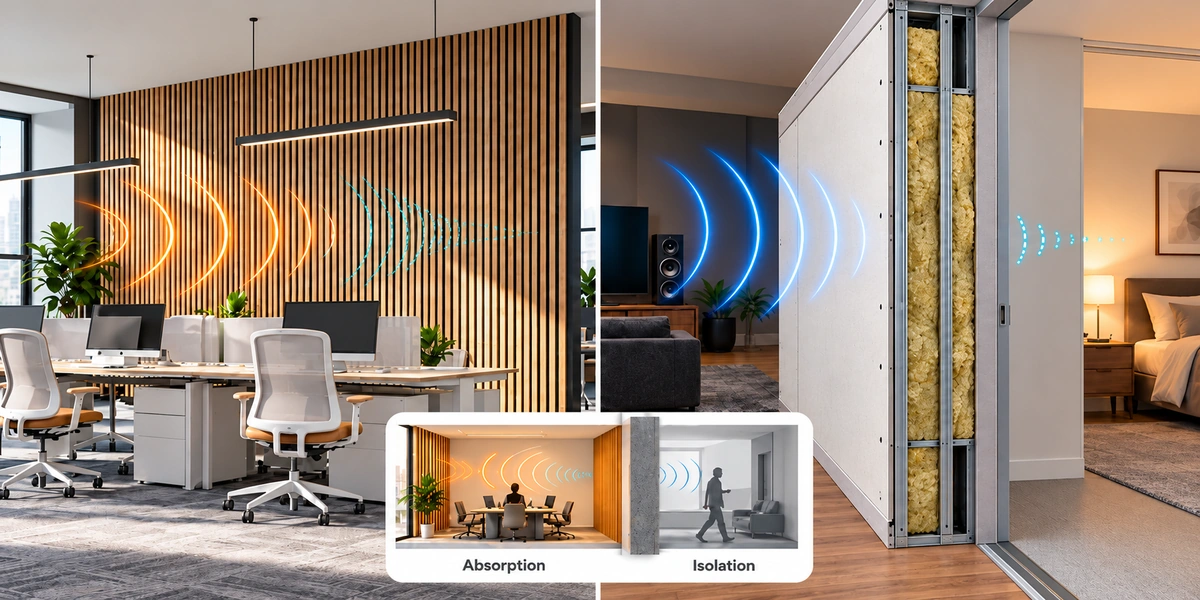
An absorptive wall panel can reduce the persistence of voices inside a meeting room without preventing speech from passing through the partition into the next office. Isolation instead depends on the entire separating assembly, including lining mass, framing or decoupling, cavity insulation, airtight joints and penetrations. Sound Transmission Class (STC) characterizes the tested airborne sound insulation of an assembly, not the absorption of a decorative wall finish.
Use absorption data (such as frequency-band coefficients and NRC) to select room treatment; use partition tests and project isolation targets when the problem is noise transfer between rooms.
Wall-Mounted Acoustic Treatment Panels
Wall-mounted acoustic treatment includes the finished panel and its supporting installation assembly.
Feltlite’s acoustic wall panel range includes four construction families: wood-slat panels on PET felt, fabric-wrapped glass-fiber absorbers, CNC-engraved PET felt and molded 3D PET tiles. They solve different design and installation problems.
The product family should narrow the technical review, not replace it. Use the comparison below to choose a plausible system first, then match the selected model and mounting option to the available acoustic and fire evidence.
| Feltlite family | Construction/catalog format | Typical installation | Critical project check |
| Acoustic Slat | MDF/wood slats on PET backing; 18 or 21 mm nominal | Screws through PET backing or compatible adhesive | Slat direction, ends, substrate and tested backing/cavity |
| Fabric-Wrapped | Textile/fiberglass-fabric facing over glass-fiber core; 25 or 50 mm options | Frame-dependent adhesive, clips/buckles or nails | Fabric permeability, frame, edges and removability |
| Engraved PET | CNC-cut or V-groove PET felt; 9-15 mm across listed patterns | Compatible adhesive on clean, level prepared wall | Groove pattern, sheet alignment and adhesive |
| 3D PET Tiles | Molded felt modules, approx. 15-53 mm finished relief by model | Model-dependent adhesive or approved mechanical fixing | Exact mold, rotation, perimeter depth and joints |
How Project Requirements Determine Panel Performance
Panel selection should begin with the room’s intended use and acoustic performance targets.
In meeting rooms, early reflections and reverberation can interfere with speech. In open offices, the design must also address speech propagation, workstation separation and the distribution of absorbent surfaces. Treating one decorative wall is not automatically enough.

The project team should establish relevant frequency bands, determine suitable wall coverage, and verify the required absorption using the intended mounting system.
For application-specific considerations, see this meeting room acoustic design guide.
How to Evaluate Sound Absorption Performance
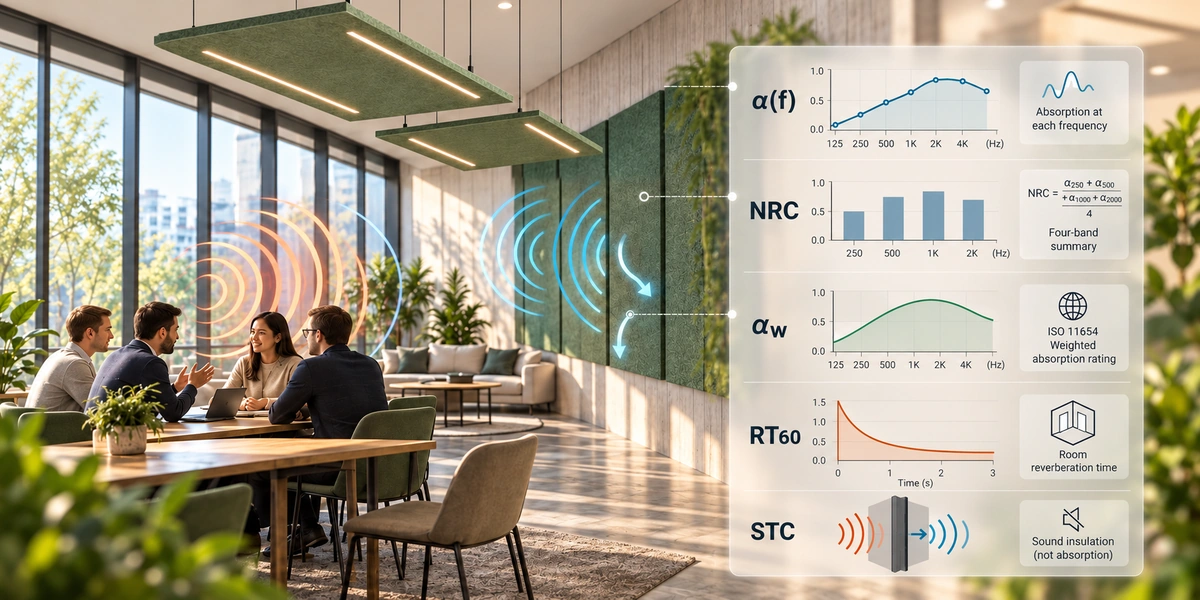
Start with the absorption coefficients by frequency, then use NRC or αw as a summary. A panel that is strong at 1,000-2,000 Hz may not deliver the same benefit at 125-250 Hz, so the target bands depend on the room, its surfaces, and the identified acoustic problem.
Understanding Frequency-Dependent Absorption Coefficients
The sound absorption coefficient, α(f), describes absorption at a particular frequency.
Laboratory reports commonly present octave-band or one-third-octave-band results. These show how absorption varies across the frequency spectrum.
A panel performing well at speech-related mid and high frequencies may perform differently at low frequencies.
Reverberation-room measurements can also produce apparent coefficients exceeding 1 because of the measurement method and edge effects.
What NRC Measures—and What It Does Not
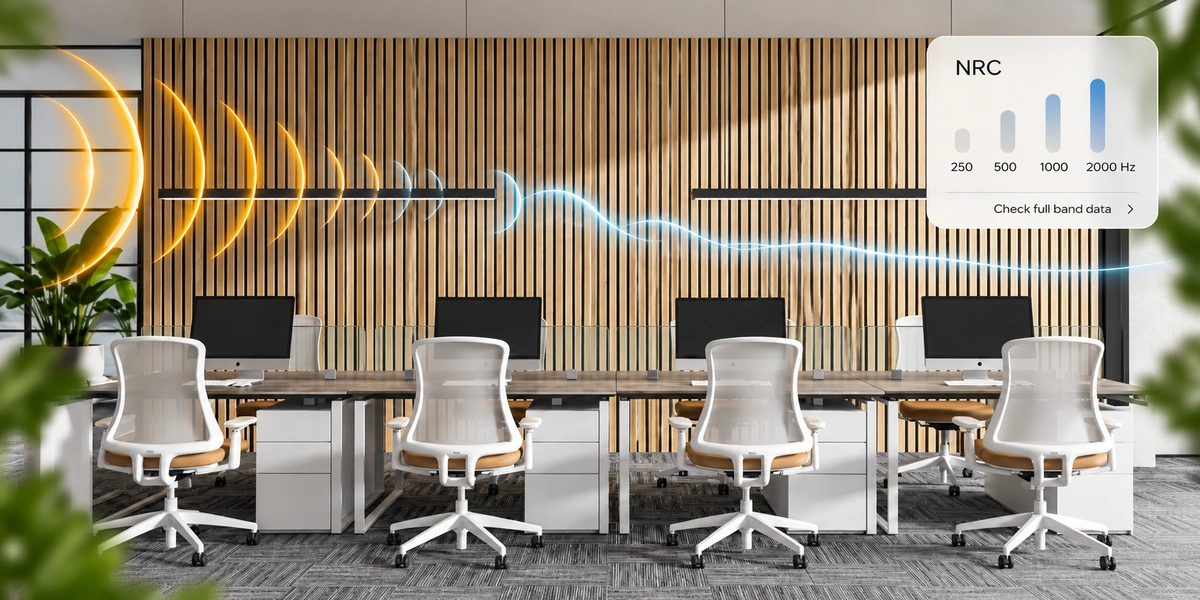
NRC summarizes absorption coefficients at 250, 500, 1,000, and 2,000 Hz. Their arithmetic average is rounded to the nearest 0.05 under the applicable ASTM procedure.
It provides a convenient preliminary comparison but does not describe 125 Hz absorption, room reverberation time (RT60), or sound insulation.
NRC must always be associated with a tested specimen and mounting configuration. For further explanation, see NRC vs. RT60 explained.
Understanding αw and ISO-Based Acoustic Ratings
The weighted sound absorption coefficient, αw, is determined using the rating procedure in ISO 11654, based on sound absorption measurement data such as those obtained under ISO 354.
Although NRC and αw both summarize acoustic absorption, their calculation methods differ.
They should not be treated as numerically interchangeable. Specifications must identify the required measurement and rating standards.
Why Similar NRC Values Can Hide Different Performance
Imagine two products with the same published NRC (a hypothetical example, not Feltlite test data). One absorbs more in the 500-1,000 Hz bands while the other is stronger around 250 Hz.
Those two profiles can produce different results when the room’s main problem is lower-frequency build-up rather than short speech reflections. Both may be valid products, but they are not acoustically identical.
A single-number rating hides the frequency distribution that a room-acoustic calculation actually uses.
Compare both reports band by band, then ask whether each panel was tested with the same backing, cavity and exposed-area convention. If the assemblies differ, record that limitation rather than declaring a winner from NRC alone.
Matching Absorption Data to the Project’s Acoustic Objective
Start with a measurable room objective, such as a project-specified reverberation target in the relevant occupied condition, and identify which bands require more absorption.
Next, relate the reported coefficients to the installed panel area. A strong coefficient on a small feature wall may contribute less total absorption than a moderately absorbing treatment covering a larger practical area.
RT60 may be relevant in meeting rooms, while open offices require additional consideration of speech propagation.
For room-level calculations, see how to calculate acoustic treatment requirements.
Acoustic performance metrics and their specification applications
| 音響測定法 | それは何を測定するの | Main Limitation | Specification Use |
| α(f) | Absorption at individual frequency bands | Assembly-specific; not a room result | Frequency-based selection |
| nrc | Four-band absorption summary | Excludes low-frequency detail and room performance | Preliminary screening |
| αw | ISO weighted absorption rating | Not directly interchangeable with NRC | ISO-based specifications |
| RT60 | Room reverberation time | Depends on volume, surfaces, and occupancy | Room acoustic targets |
| STC | Sound insulation of a tested assembly | Not a wall panel absorption metric | Separate sound isolation design |
How to Read an Acoustic Panel Test Report
A reliable acoustic panel evaluation begins with the complete laboratory report, not an isolated rating on a marketing brochure. The central question is whether the tested construction represents the product and installation proposed for the project.

1. Verify the Tested Product and Sample Construction
Start with the exact model, facing, backing, finished thickness and specimen size. A report for an unfinished PET sheet, for instance, does not automatically describe an engraved or formed PET product.
Look for a cross-section or sufficiently detailed sample description. It tells you whether the tested surface includes fabric, slats, grooves, supporting frame or additional backing that could affect the absorption curve.
Decision rule: if the ordered facing, core or geometry is materially different from the test specimen, the reported rating is evidence for a related product, not direct proof of this exact configuration.
2. Confirm the Acoustic Test Standard
Find the laboratory, test date, standard and edition before reading the advertised rating. This establishes the measurement basis and whether the full dataset is available for comparison.
ASTM C423 あんど ISO 354 are recognized reverberation-room measurement methods.
NRC and αw are rating outputs, not interchangeable test methods.
The specification should document which standard applies and confirm that the report provides the required measurements.
3. Review the Mounting Configuration
Determine how the specimen was installed during testing.
Important details include direct mounting, supporting frames, cavity depth, backing materials, edge treatments, and joints.
For example, data obtained with an air cavity cannot automatically substantiate performance for a panel bonded directly to a rigid wall.
Request the tested mounting description and compare it with the proposed installation drawings.
4. Examine the Full Frequency Absorption Data
Look for the octave- or one-third-octave-band table, ideally including the low-frequency bands relevant to the brief. Check that the report identifies coefficients, equivalent absorption areas or another quantity correctly.
Check whether results are presented as sound absorption coefficients or equivalent absorption areas.
Place the target bands beside the results and note strengths and gaps. This reveals whether a promising overall NRC conceals underperformance at a frequency the project actually needs to control.
For comparison, use like-for-like frequency bands and reported quantities. A plotted summary or marketing figure without the underlying values cannot support this step.
5. Check Whether the Report Applies to the Ordered Product
Even within Feltlite’s catalog, an 18 mm slat system, a 50 mm fabric-wrapped panel, an engraved PET sheet and a deep molded tile are different constructions. A test for one should never be relabeled as evidence for the others.
Changes in facing permeability, slat spacing, groove geometry, backer, air gap or adhesives can affect the finished assembly. Customization is therefore an acoustic question as well as a visual choice.
If a proposed variation is outside the scope of the available report, record it as an evidence gap and resolve it with product-specific documentation, an accepted assessment or testing as the project requires.
Acoustic test report verification checklist
| Test Report Field | What to Verify | なぜ重要なのか | Possible Red Flag |
| Tested product | Model, construction, thickness, finish | Product identification | Generic material name |
| テスト方法 | Standard and edition | Measurement traceability | Rating without method |
| Laboratory & date | Issuer, date, complete report | Document verification | Missing report pages |
| 取付け | Cavity, backing, fixing, edges | Assembly comparability | Different site installation |
| 周波数データ | Band results and units | Performance verification | Marketing rating only |
| Ordered configuration | Match with project drawings | Evidence applicability | Unverified customization |
| Document status | Revision and attachments | Approval traceability | Incomplete documentation |
How Panel Construction and Thickness Affect Acoustic Performance
Thickness, porosity, airflow resistance, surface coverage, backing, and exposed geometry work together. The four Feltlite wall-panel families illustrate why there is no useful universal thickness-to-NRC conversion.
Panel Thickness and Frequency Response
Increasing the depth of a porous absorber often improves absorption toward some lower frequencies, but the outcome still depends on airflow resistance and mounting. Compare thickness options inside the same tested product family wherever possible.
For example, Feltlite lists 25 and 50 mm fabric-wrapped panel options, while engraved PET designs use much thinner felt with CNC-cut surfaces. Their thicknesses describe different constructions, not two steps on one performance scale.
A thicker product does not necessarily deliver a proportionally higher NRC; a slatted facing or a backing layer may change how much sound reaches the absorber.
The useful decision is whether the selected build-up supplies absorption in the target bands and can be installed in the space available.
Material Density and Airflow Resistance
Density helps describe how a panel is made but cannot independently establish its absorption. Material with very low airflow resistance may transmit much of the incident energy; very high resistance may reflect more than the design intends.
Volumetric density, measured in kg/m³, differs from areal density, measured in g/m² or kg/m².
Airflow resistance also affects porous absorption; values that are excessively low or high may be unsuitable for particular configurations.
Interpret density together with airflow characteristics, finished panel thickness and the measured absorption curve. The density values of a glass-fiber core and the areal weights of PET felt sheets should not be compared as though they were the same measurement.
Backing Materials and Composite Panel Construction
Feltlite slat panels combine timber or MDF slats with a PET backing; fabric-wrapped models use a thicker glass-fiber core with a chosen textile and frame; engraved PET and molded 3D PET are shaped felt constructions. The face exposed to sound is therefore different in every case.
For wood slats, pay attention to the percentage of open area and backing; for fabric-wrapped panels, the fabric and core; for engraved PET, the remaining felt and groove geometry; and for 3D tiles, relief depth and the joint pattern.
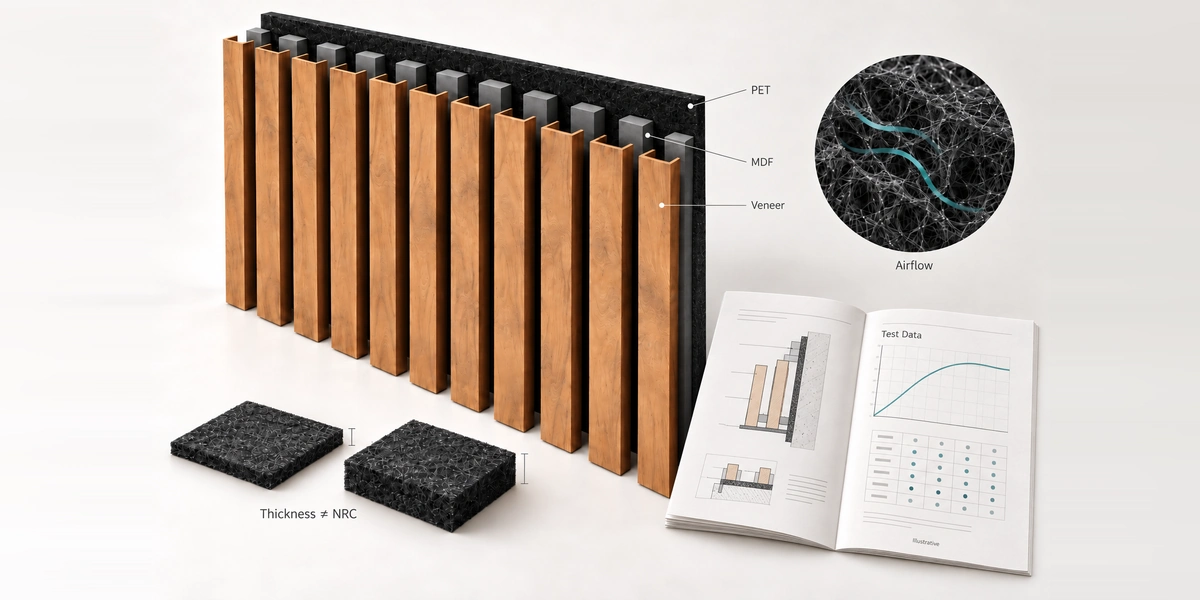
An acoustic report for plain PET felt cannot automatically substantiate a fabric-wrapped panel, timber-slat assembly, or molded relief tile. Compare the construction cross-section before comparing the ratings.
Why Nominal Thickness Cannot Replace Test Data
Nominal thickness describes a physical dimension, not complete acoustic performance.
Before approval, request a finished construction drawing, frequency-band absorption report, mounting detail, and confirmation of permitted customization.
Where deeper material analysis is required, the guide to PET felt acoustic properties explains relevant material behavior.
Panel construction verification matrix
| Construction Parameter | Acoustic Relevance | Information to Request |
| Panel thickness | Influences frequency response | Finished dimensions and test data |
| Density / areal density | Describes material structure | Units and measurement basis |
| Airflow resistance | Influences porous absorption | Applicable test information |
| Facing / backing | Changes assembly response | Construction section |
| Grooves / composite geometry | Changes finished configuration | Drawings and report coverage |
How Mounting Conditions Change Acoustic Wall Panel Performance
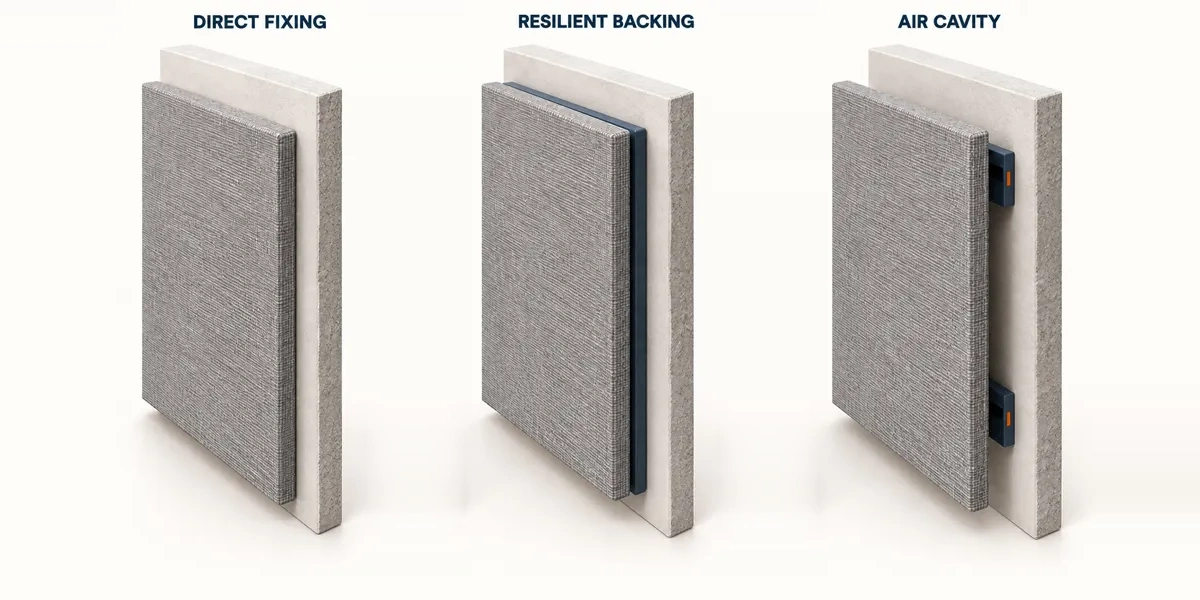
Mounting conditions can substantially change the frequency response of acoustic wall panels. The installed assembly should therefore be compared with the laboratory configuration before performance claims are accepted.
Direct-to-Wall Installation
Direct fixing puts the product against a prepared wall, usually leaving little intentional cavity. This can simplify wall depth and detailing, but should be matched to direct-mount acoustic data if a target rating is being specified.
Feltlite engraved PET panels typically use compatible adhesive on a clean, level, dry substrate. Pattern alignment, joint width and glue compatibility are key site controls; they matter even if the finish appears to be a simple flat sheet.
Wood-slat panels may instead be fixed through the PET backing with screws or suitable adhesive. The timber modules also require a set-out for slat direction, cut ends and outlets.
Choose direct fixing for the project’s geometry and fixing constraints, not on an assumption that the highest rating from an air-gap test carries over unchanged.
Wall Panels with an Air Cavity
An air cavity behind a porous wall treatment changes the depth at which the sound interacts with the absorber and may improve selected lower-frequency bands, depending on the panel and cavity.
The size and effect of the cavity depend on framing, backing and edge conditions. The apparent acoustic face may be the same, but the tested assembly is no longer the same.
A deeper cavity is not automatically better at every frequency or in every room.
For a cavity-mounted slat or fabric-wrapped design, record the proposed stand-off dimension in the elevation or section and compare it with the mounting arrangement associated with the report.
Mechanical Fixing and Adhesive Mounting
The four Feltlite families do not share one universal fixing detail. Slat panels can use screws through PET backing; fabric-wrapped panels may use adhesive, clips or nails depending on frame; engraved PET commonly uses substrate-compatible adhesive; and 3D PET modules may use approved adhesive or mechanical options according to the model.
This matters on site: a fabric-wrapped frame determines removability and joint appearance, while a 3D tile needs sufficient depth at switches, corners and the last module. Adhesive suitability and fire documentation also depend on the construction.
Decide at drawing stage which elements need removal for access, where penetrations will occur and whether the chosen wall build-up permits the proposed fastening method.
Do not copy a bracket spacing or an adhesive detail from a different product family. Such a substitution may compromise support even if the visible panel face appears similar.
Why the Installed Assembly Must Match the Specification
The laboratory assembly, project specification, approved sample and site installation must tell the same story. Otherwise, a correct laboratory number can become irrelevant to the actual wall.
If site conditions require a changed backing, filled cavity, or alternative fixing method, the contractor should issue a technical clarification or Request for Information (RFI).
A change in cavity depth, infill or fixing should trigger a targeted review: Does it alter the measured acoustic configuration, the safe attachment or the scope of the fire report?
Wall panel mounting comparison
| Mounting Condition | Acoustic Implication | Structural Consideration | Verification Needed |
| Direct-to-wall | Use relevant direct-mount data | Substrate and joints | Tested construction |
| With air cavity | Frequency response may change | Frame and cavity depth | Matching report |
| Mechanical fixing | Support can alter assembly | Loads and maintenance | Approved fixing drawings |
| Adhesive mounting | Depends on complete installation | Compatibility and site conditions | Approved adhesive system |
How to Compare Two Acoustic Panel Test Reports
Comparing suppliers is a two-stage decision: first establish whether their tests describe comparable installed assemblies; only then compare the frequency results against the room objective.
Where the reports are not comparable, the outcome should be a clear question or next step, not an unsupported ranking.

1.Confirm Comparable Panel Construction
Make one row for each reported assembly and identify the core, face, backing, thickness and visible geometry. For example, wood slats on PET backing are not the same specimen as fabric over glass wool.
Identify whether the proposed products are equivalent assemblies or different treatment systems.
Two unlike constructions can both be suitable for a project. The comparison must explain why each meets the brief rather than imply they should have identical material descriptions.
2.Check Whether Mounting Conditions Are Equivalent
Compare cavity depths and mounting types as well as edge conditions, exposed sample area and standard. These details may explain why the tested results diverge.
A report obtained using a framed cavity installation may not be directly comparable with a report for a flush-mounted panel.
If one report uses a stand-off cavity and the other is direct-fixed, write “mounting not comparable” until equivalent test conditions or a project-specific assessment support a fair conclusion.
3.Compare Frequency-Band Results, Not Just Single-Number Ratings
Enter the coefficients for matching frequencies into one comparison sheet and highlight the bands needed for the actual room. Do not compare an octave value with an unrelated one-third-octave point.
For example, if control of lower-frequency build-up matters, inspect 125 and 250 Hz instead of deciding solely from the averaged NRC. Also consider usable panel coverage.
Avoid converting NRC into αw or treating their values as equivalent.
Select the solution that meets the project objective and installation constraints with acceptable evidence; the largest single-number rating is not necessarily the best specification.
4.Identify Missing or Non-Comparable Information
An honest comparison can end with three outcomes: comparable and suitable; potentially suitable with a defined evidence gap; or unsuitable for the current design.
List each missing item beside the decision it affects: a mounting section affects acoustic applicability; a construction description affects product identity; and a fire classification affects code review.
Keep the status of each clarification visible so procurement does not mistake an unresolved technical question for approval.
Do not approve a substitution on a marketing value alone when the tested assembly or required compliance documents cannot be identified.
BLANK WORKSHEET — Supplier A vs. Supplier B (fill in with your own report data)
This is a fill-in evaluation worksheet for readers, not an unfinished results table. Both supplier columns intentionally contain prompts instead of values. Copy the table, enter the figures and construction details from each supplier’s actual test report, then use the last column to record your decision. No Feltlite or competitor results are implied.
| Comparison Item | Supplier A (fill in) | Supplier B (fill in) | Evaluation Question |
| 製品の構造 | Enter core / facing / backing | Enter core / facing / backing | Comparable assemblies? |
| Panel thickness | Enter finished thickness | Enter finished thickness | Equivalent construction? |
| 取り付け状態 | Enter mounting / cavity | Enter mounting / cavity | Same cavity and backing? |
| Test standard / edition | Enter standard / edition | Enter standard / edition | Comparable methods? |
| Frequency absorption | Enter band values / report page | Enter band values / report page | Meets target bands? |
| Fire documentation | Enter report ID / scope | Enter report ID / scope | Covers ordered product? |
| Missing information | List missing items | List missing items | Further clarification needed? |
Fire Performance and Compliance for Commercial Acoustic Wall Panels
For commercial walls, reaction-to-fire and indoor-air documentation must be matched to the destination market and installed assembly. A material rating is not a blanket approval for every finish or installation.
Material-level claims alone are not sufficient evidence of project compliance.
Understanding Applicable Fire Test Standards
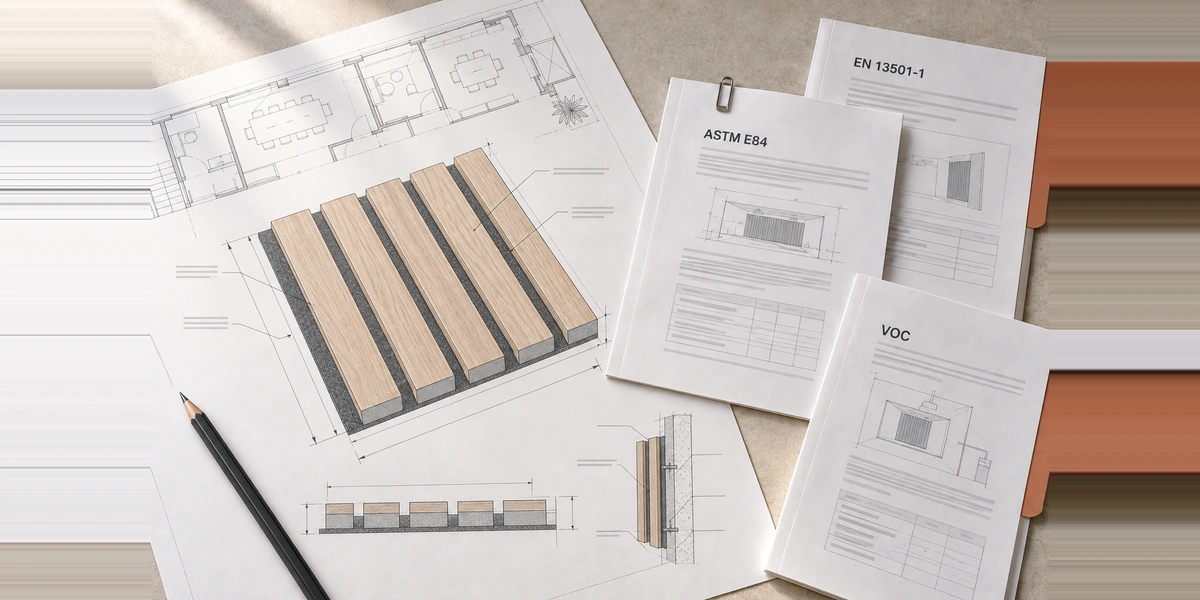
ASTM E84 measures comparative surface-burning characteristics, including flame spread and smoke development, under specified test conditions.
EN 13501-1 provides a European reaction-to-fire classification framework.
These systems use different methods and classification approaches. Their ratings should not be assumed equivalent.
An ASTM E84 classification also does not, by itself, establish that a material is noncombustible.
Material Fire Ratings vs Installed Assembly Requirements
A test covering the bare PET felt, or the glass-fiber core, might not cover a finished combination of wood, fabric, frame, backing and fixing products.
For instance, Feltlite lists fire-related catalog information for individual product families, but the applicable classification and its scope must be checked for the exact finish and destination market. An ASTM E84 result is not interchangeable with EN 13501-1.
When a project requires assembly-level evidence, identify whether the report includes surface finishes, adhesives, supporting layers, and end-use conditions. Do not assume a raw-material class transfers to the wall as installed.
Treat an attractive headline rating as a starting point for documentation review, not a promise that all variations of all four wall-panel families achieve the same result.
Indoor Air Quality and Material Documentation
Commercial projects may require VOC emissions testing, material declarations, or other environmental documentation.
Request the relevant reports, issuing organizations, test methods, and applicable product identification.
Where required, evaluate adhesives and surface finishes separately or as part of the documented assembly.
Avoid unsupported claims such as “zero VOC,” “non-toxic,” or universally environmentally safe.
Confirming Compliance for the Destination Market
Specify the destination country, building occupancy, relevant code requirements, and requested documentation in the project inquiry.
The supplier should confirm available evidence, while the project’s architect and fire or code consultant determine its applicability.
Compliance requirements vary by jurisdiction and building use.
This document-review framework does not replace local code approval or professional assessment.
Commercial acoustic panel compliance checklist
| Compliance Requirement | Document to Request | Verification Point |
| ASTM E84 | Complete applicable report | Product and mounting scope |
| EN 13501-1 | Classification report | End-use applicability |
| VOC / indoor air | Applicable emissions documentation | Tested material or assembly |
| Environmental declarations | Project-required declarations | Product identification |
| Market compliance | Project code checklist | Jurisdiction and occupancy |
How to Specify Panel Dimensions, Finishes and Installation Details
A workable acoustic panel specification needs enough detail for the chosen product to be manufactured, installed and matched to the intended acoustic evidence.
The specification must identify not only the panel’s appearance but also the construction approved for procurement and installation.
Finished Dimensions and Thickness
Record finished width, height, thickness and tolerances by product family. Feltlite’s slat modules, fabric-wrapped rectangles, engraved PET sheets and molded 3D tiles use different grids; a generic “standard panel” size is not sufficient.
Distinguish catalogue dimensions from dimensions established in approved production drawings.
Joint widths, layout coordination, and dimensional changes should be reviewed before manufacturing.
For reference, the current Feltlite catalog lists slat options at 18/21 mm, fabric-wrapped absorbers at 25/50 mm, engraved PET at several 9-15 mm series options and selected 3D PET profiles at approximately 15-53 mm depth. Final dimensions must come from the exact selected model.
Surface Finish, Color and Edge Treatment
Specify wood veneer and slat direction, fabric and frame edge, engraved groove orientation or 3D module rotation as applicable. These are part of the final geometry, not merely decorative selections.
Approve physical samples where appearance is important.
Document corner conditions, exposed edges, and transitions to adjacent finishes.
Color consistency should be judged against agreed samples and manufacturing tolerances, rather than an unsupported guarantee of identical appearance across batches.
Wall Substrate and Fixing Requirements
Name the wall substrate and the family-specific fixing method. Feltlite’s adhesive-installed engraved PET, mechanically fixed slat backing, framed fabric modules and molded 3D tiles require different installation coordination.
Coordinate these details with fire documentation and the tested acoustic mounting configuration.
Before production, check which joints, perimeter conditions and penetrations need coordinated shop drawings. A flush module layout that looks correct on paper can drift on site without datum lines.
Do not specify universal adhesive quantities, screw spacing, or load capacities without supporting manufacturer documentation.
Custom Panel Geometry and Project Drawings
Custom dimensions, CNC grooves, molded relief, service openings and irregular boundaries should be drawn and approved at the model level. A new pattern can alter both the amount of exposed absorber and the installation sequence.
These modifications may affect the finished assembly and the applicability of previous acoustic or fire reports.
Where a customized product differs from the tested configuration, identify whether additional evidence is needed for the target performance or applicable fire classification.
Approve the final geometry before production begins.
Acoustic wall panel specification checklist
| 仕様項目 | プロジェクトの要件 | Supplier Confirmation |
| Product family / model | Selected system and SKU | Model and catalogue revision |
| Finished size / thickness | Dimensions and tolerances | Finished drawings |
| Surface / color / edges | Approved finish schedule | Samples and edge details |
| 音響性能 | Relevant bands and mounting | Applicable test report |
| Fire / VOC | Project-specific requirements | Report coverage |
| Substrate/fixing | Wall and cavity details | インストール手順 |
| Customized geometry | Openings, grooves, profiles | Performance applicability |
What Should a Complete Acoustic Panel Submittal Include?
A project submittal should connect a named panel family and model to its construction, performance, fixing method, finish, and project approval. The checklist below can be used after the selection process described above.
This is particularly important when a project combines different Feltlite families on different walls or integrates wall treatment with ceiling absorption.
Product Data Sheets and Construction Details
Request product data sheets identifying the manufacturer, product family, model, material composition, finished dimensions, thickness, and document revision.
Include construction sections showing facings, cores, and backing layers.
Check that product descriptions match the purchasing schedule.
A generic catalogue or unlabelled material sheet should not substitute for model-specific technical information.
Acoustic and Fire Test Documentation
Submit complete acoustic reports with their standards, tested construction, mounting conditions, and frequency results.
Fire reports should identify the applicable product or assembly, test method, classification, and supporting scope.
Check the issuing laboratory or organization, report date, and revision.
Acoustic and fire documentation must be reviewed independently against the proposed configuration.
Shop Drawings and Installation Information
Shop drawings should identify wall layouts, panel joints, perimeter details, fixing methods, cavity dimensions, substrate requirements, and equipment penetrations.
They should also show interfaces with other construction trades.
The contractor must raise an RFI where site conditions require deviations from approved details.
The responsible design professionals should review the resulting technical implications.
Finish Samples and Project Approval Records
Include physical finish samples, color references, edge details, and mock-up records where required.
Record which sample or drawing revision was approved, by whom, and on what date.
Document later changes and replacement approvals.
This establishes a traceable connection between the reviewed design and the delivered materials.
Maintenance and Replacement Information
The final operation and maintenance documentation should include approved cleaning methods, replacement procedures, product identification, and spare material information.
Confirm any limitations associated with dismantling, reinstallation, or replacement finishes.
Facility managers should receive the relevant information at handover.
For model-specific information, review the Feltlite Acoustic Wall Panels range and request the appropriate technical documents.
Acoustic panel submittal responsibilities
| Submittal Document | Required Content | Purpose | Approval Responsibility |
| Product data sheet | Model, construction, dimensions | Confirm product identity | Supplier / Specifier |
| Acoustic test report | Standard, bands, mounting | Verify absorption | Acoustic consultant |
| Fire / environmental reports | Classification and scope | Review compliance | Fire / Code consultant |
| Shop drawings | Layout and fixing details | コーディネートの | Architect / Contractor |
| Finish samples / mock-up | Finish and approval record | Confirm appearance | Architect / Client |
| O&M / replacement information | Maintenance and spares | Support handover | Contractor / Facility team |
結論
Specifying acoustic treatment panels for commercial projects requires more than comparing advertised NRC ratings or nominal panel thicknesses.
Reliable selection depends on identifying the finished assembly, reviewing frequency-band absorption data, confirming tested mounting conditions, and verifying relevant fire and environmental documentation.
Architects, acoustic consultants, and procurement teams should use complete technical reports and coordinated project drawings to support approval decisions.
探検する Feltlite Acoustic Wall Panels あんど contact Feltlite for project details with your drawings, installation conditions, target performance requirements, and requested technical documentation.
よくある質問
スティーブン・リー脚本の
コンテンツとマーケティングのスペシャリストジャッキー・タンによるテクニカルレビュー
マーケティング マネージャー
メール: info@feltlite.com