Acoustic Lighting Solutions — From Feature Pendants to Ceiling Systems
Feltlite acoustic lighting solutions bring architectural illumination and sound-absorbing PET felt together in pendant, panel, linear and baffle formats. The collection includes seven illuminated product families and unlit Acoustic Blades for ceiling areas where additional absorptive material is useful but another light source is not.
Compare each family by form, lighting role, acoustic surface and layout scale—from feature pendants above reception and meeting points to broader lighting rafts, continuous linear fixtures and repeated baffle systems. Standard products provide a practical starting point, while size, felt color, output, CCT, dimming, suspension, labeling and packaging can be coordinated for commercial projects and OEM programs.
Define the lighting task
Establish illuminance, distribution, visual comfort, CCT and controls before selecting the surrounding felt form.
Plan the acoustic contribution
Compare exposed PET felt area, orientation, quantity and suspension as part of the room’s wider absorption strategy.
Relate form to the space
Use furniture geometry, occupied zones and ceiling rhythm to choose panel, circular, linear, dome, radial or baffle formats.
Complete the specification
Coordinate visible, electrical, mounting and supply details so the approved configuration can move reliably into production.
Coordinate Illumination And Sound Absorption Within One Ceiling Strategy
Acoustic lighting combines a functional light source with porous sound-absorbing material, usually PET felt, in a suspended fixture or coordinated ceiling system. It is particularly relevant where glass, concrete, plasterboard, hard floors and exposed ceilings allow speech and activity noise to reflect through offices and commercial interiors.
The category ranges from compact decorative pendants to broad lighting rafts, furniture-aligned linear luminaires and ceiling-scale baffle systems. Each format places a different amount of felt in a different orientation, so selection should begin with the room use, furniture plan, required light distribution and intended scale of acoustic treatment.
Acoustic light fixtures can simplify the coordination of luminaires and absorbers above the same occupied zone, but they do not remove the need for lighting calculations, acoustic planning or additional wall and ceiling treatment where the room requires it.
What belongs in this collection?
Seven illuminated families: Acoustic Panel, Ring, Linear, Dome, Felt Shade, EchoSlice and Acoustic Baffle Lights combine a light source with a visible PET felt body.
One coordinated unlit family: Acoustic Blades provide no illumination. Use them independently or with Acoustic Baffle Lights when the ceiling needs additional felt without the same density of lighting points.
One important boundary: these products address reflected sound within the room. They do not stop noise passing through walls, doors, floors, glazing or ceilings.
Three Design Layers Determine Whether The Solution Works
A commercial acoustic lighting solution coordinates lighting, sound absorption and ceiling integration—three decisions that are often developed by different disciplines. Bringing them into one product can simplify the visual language and procurement scope, but each layer still needs to be evaluated properly.
The fixture must illuminate the intended activity, introduce useful exposed acoustic material and fit around furniture, suspension points and building services. A successful specification is therefore based on the complete project relationship rather than the pendant silhouette or one isolated material figure.
Choose An Acoustic Lighting Family By Form, Function And Layout
Use the filters to narrow the collection by ceiling role. Each card identifies the light-source format, primary placement and typical composition before you move to the detailed product specifications.
Broad panels prioritize horizontal acoustic coverage, linear products follow long furniture and circulation, sculptural pendants define individual destinations, and baffle systems build a repeated architectural rhythm across larger ceilings. Acoustic Blades remain a separate unlit option for extending felt coverage where another luminaire is unnecessary.

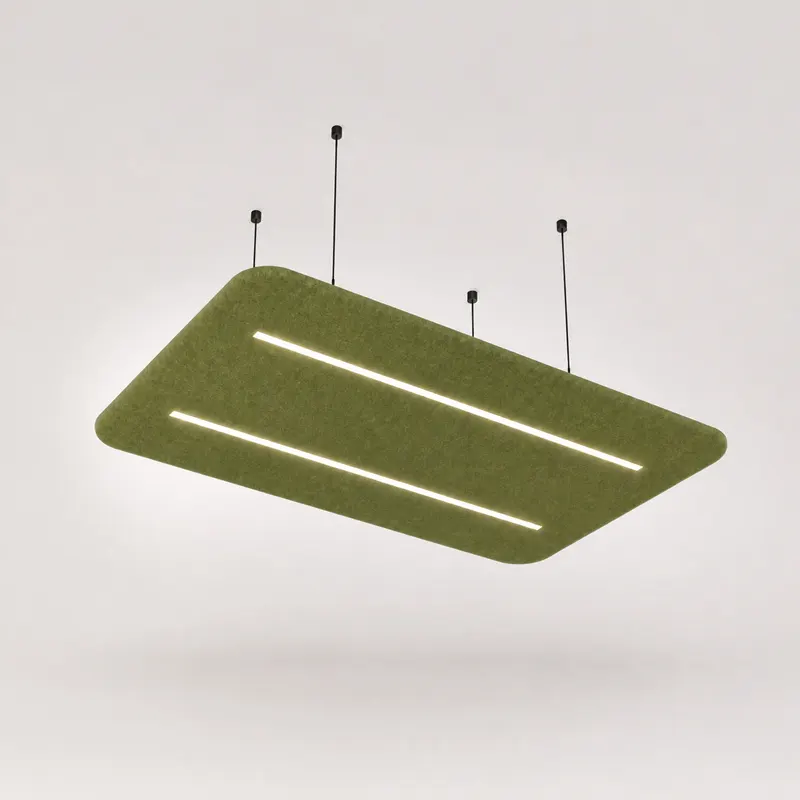
Round and rectangular PET felt panels combine useful downward illumination with the broadest horizontal acoustic surface in the collection. Use them where the ceiling should relate directly to workstation groups, meeting tables or distributed furniture zones.
- Best aboveWorkstations & tables
- FormRound / rectangular
- LayoutSingle / rows / clusters
- Best aboveReception & lounges
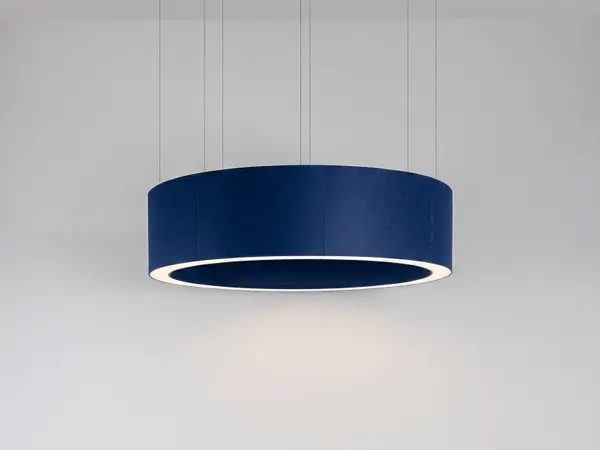
- FormOpen circular ring
- LayoutSingle / cluster

- Best aboveLong tables & desk rows
- FormHorizontal linear
- LayoutSingle / continuous run

- Best aboveTables & conversation zones
- FormDeep dome
- LayoutSingle / repeated

- Best aboveCompact tables & seating
- FormFolded polygonal shade
- LayoutSingle / repeated

- Best aboveMeeting & reception points
- FormRadial circular fins
- LayoutSingle / repeated

- Best aboveOpen offices & large zones
- FormVertical baffle luminaire
- LayoutSingle / long runs

- Best aboveLarge shared spaces
- FormVertical PET felt blade
- LayoutStandalone / paired
Compare Product Form, Placement And Lighting Role
Use this table to identify the most appropriate starting family. It compares the decisions that matter at category level: physical form, relationship to the occupied zone, lighting role and the way each product can be arranged across the ceiling.
The table intentionally avoids treating one wattage, size or acoustic figure as representative of the complete collection. After selecting a format, open the relevant product page to review available models, light sources, controls and project-specific options before requesting a quotation.
Product Family | Primary Form | Best Used Above | Lighting Role | Typical Layout |
|---|---|---|---|---|
Panel Pendant | Solid round or rectangular panel | Workstations, conference tables, classrooms | Broad downward illumination | Single raft, aligned rows or clusters |
Ring Pendant | Open-center circular ring | Reception, lounge and hospitality areas | Architectural circular light | Single feature or cluster |
Linear Pendant | Horizontal linear profile | Long tables, workstation rows, corridors | Continuous furniture-aligned light | Single unit or continuous run |
Dome Pendant | Deep concave shade | Meeting, dining and conversation zones | Localized E27 downlight | Single or repeated pendants |
Felt Shade | Compact folded shade | Small tables, desks and consultation areas | Replaceable E27 source | Single or repeated pendants |
EchoSlice | Radial circular felt fins | Meeting points, reception and exhibitions | Diffused central feature light | Single, row or repeated layout |
Baffle Light | Vertical felt with linear LED | Open offices and large ceiling zones | Continuous integrated illumination | Single fixture or long system |
Acoustic Blades | Unlit vertical felt blades | Shared ceilings needing added coverage | No light source | Standalone or paired with Baffle Light |
Start With The Room, Furniture And Lighting Task
A sculptural form may attract attention, but a reliable acoustic lighting specification begins with the activity below and the ceiling conditions above. The product must relate to people, furniture and required illumination before its color or silhouette is finalized.
Define how the zone is used, how the furniture organizes it and how much useful light it requires. Then evaluate PET felt area, fixture quantity, suspension position and the wider treatment needed to support the acoustic objective without overstating what one luminaire can achieve.
Evaluate Lighting And Room Acoustics As Coordinated Requirements
An acoustic light should not be selected from its felt shape alone. It must provide appropriate visual conditions while its PET felt body is assessed as one component of the room’s total absorptive strategy.
Lighting calculations determine whether the intended area receives suitable illuminance, distribution and visual comfort. Acoustic planning considers room volume, reflective finishes, target reverberation and total installed absorption. Both influence fixture size, quantity, position and spacing, so reviewing them together early reduces later redesign.
Important: Acoustic lighting is not soundproofing and does not stop sound passing between rooms. For a formal reverberation target, use project-specific calculations or an acoustic consultant. Learn why complete fixtures should not be judged by material NRC alone in Feltlite’s guide to acoustic lighting and NRC.

Lighting Performance Comes First
The acoustic body does not compensate for unsuitable illumination. Review the following lighting inputs before selecting the surrounding felt form or approving the ceiling layout.
- Lumen output and required work-plane illuminance
- Direct, indirect or localized light distribution
- Glare and standing viewing angles
- CCT, CRI and color consistency
- Dimming protocol, voltage and driver compatibility
- Other general and emergency lighting in the room
Acoustic Contribution Belongs To The Whole Room
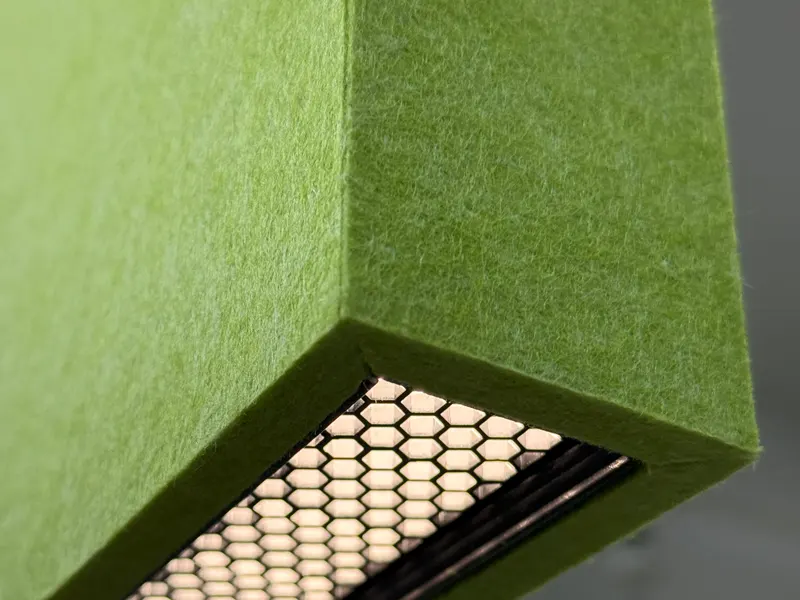
PET felt absorbs a portion of reflected sound energy, but the audible result depends on the complete installation and the surfaces that remain untreated within the interior space.
- Exposed felt area and product construction
- Quantity, spacing and suspension position
- Room volume and ceiling height
- Glass, concrete, plasterboard and other reflective finishes
- Existing wall, ceiling and furniture absorption
- Target reverberation time and speech requirements
Choose By The Scale of Treatment—Not By Appearance Alone
Acoustic lighting can identify one occupied point, serve a complete furniture zone or become part of a repeated ceiling field. Defining that scale at the beginning prevents a compact feature pendant from being expected to provide the same coverage as a broad panel or baffle system.
Many projects combine more than one level. A reception area may use a sculptural pendant as a visual landmark, while adjacent work zones use panel, linear or baffle lighting for wider and more structured coverage.

One Occupied Point
Use a Dome, Felt Shade, EchoSlice or compact Ring above a reception desk, café table, small meeting point or consultation area. The pendant defines one destination, provides localized light and adds felt close to the conversation or activity below.
Check:
Diameter, mounting height, downward light, standing sightline and whether the rest of the room needs additional treatment.

A Table or Furniture Group
Use a rectangular or round Panel Pendant, Linear Pendant or a coordinated group of sculptural pendants of different sizes above conference tables, workstation islands, library tables and collaborative furniture groups.
Check:
Furniture alignment, light uniformity, fixture spacing, exposed felt area and coordination with ceiling services.
A Repeated Overhead Field
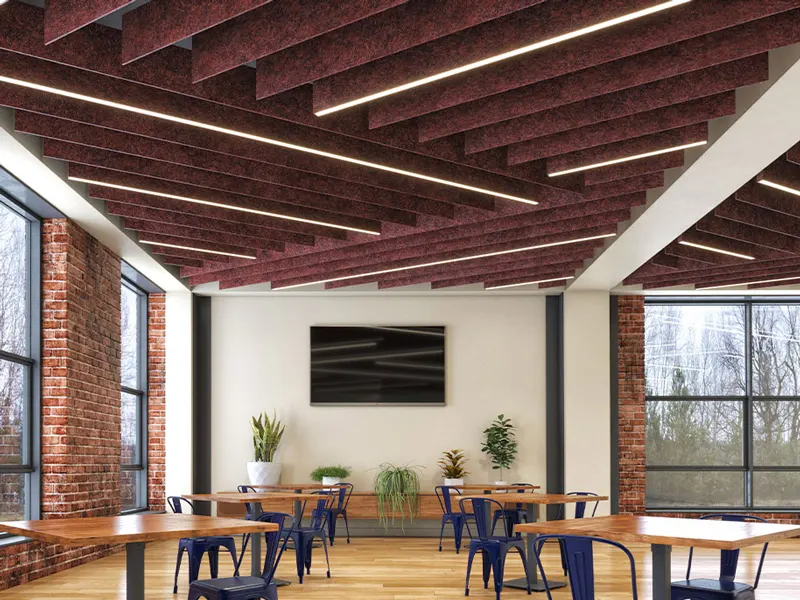
Use Acoustic Baffle Lights for illuminated runs and Acoustic Blades where an unlit element is more appropriate. Large reflective rooms may combine these systems with acoustic panels, clouds or wall treatment to achieve the required total absorption.
Check:
System rhythm, lighting density, blade quantity, suspension positions, power distribution and access for maintenance.
Match Each Acoustic Lighting Solution To The Activity Below
Room type is only the starting point. The more useful question is what happens directly below the fixture: focused work, conversation, circulation, reception, dining or informal collaboration. That activity helps define the required light distribution, visual scale and useful position of exposed felt.
Furniture geometry, ceiling height, sightlines and existing services should then refine the choice. A compact pendant may identify one table or reception point, while a panel, linear fixture or baffle system can establish stronger alignment across a larger occupied zone.
Configure The Product Around The Project And Supply Program
Most projects move more efficiently when they begin with an established Feltlite product family and adjust only the details that must respond to the interior, lighting brief, target market or brand language. This preserves a practical manufacturing basis while allowing meaningful control over scale, color and performance.
A complete configuration connects the visible felt form with the LED system, optics, controls, suspension, electrical market and commercial supply requirements. Reviewing these decisions together helps identify conflicts earlier and creates a clearer basis for sampling, quotation and production approval.
Final feasibility, MOQ, sample needs and lead time depend on the confirmed configuration and quantity.
Send the application, drawings, ceiling conditions, key dimensions, quantity, destination and preferred product family. Reference images help explain the intended visual role.
Review size, felt color, lighting package, controls, mounting, electrical market and commercial requirements. Identify all non-standard requests before pricing.
Confirm appearance, key dimensions, color, light effect, electrical details, labels and packaging. The approval route may include samples, drawings or a physical prototype.
Lock the approved configuration, quality requirements, packing plan and shipment sequence before production. Controlled specifications support consistency across repeated batches.
Practical Questions About Specifying Acoustic Lighting Solutions
The answers below address the decisions buyers, designers and project teams commonly face before selecting a product family. Product-specific dimensions, outputs and configuration options remain on the individual product pages and should be confirmed for the chosen model.
Use this section to distinguish sound absorption from soundproofing, compare fixture formats and prepare the room, lighting, ceiling and commercial information needed for a useful initial recommendation.
Acoustic lighting combines illumination with sound-absorbing material in one fixture or coordinated ceiling system. Feltlite uses porous PET felt around an integrated LED module or, in selected decorative products, an E27 light source. The aim is to coordinate two ceiling requirements while also introducing shape, color and texture.
The porous felt absorbs part of the reflected sound energy that would otherwise return from hard surfaces such as glass, concrete and plasterboard. The installed contribution depends on the exposed felt area, product construction, quantity, spacing and suspension position, as well as the room volume and other absorptive finishes. It should therefore be assessed as part of the complete room rather than as an isolated decorative object.
No. Acoustic lighting can contribute to controlling reflections, echo and reverberation inside a room. Soundproofing addresses sound transmission between rooms through walls, doors, floors, ceilings and penetrations, so it requires different construction systems and detailing.
Not automatically. A localized acoustic pendant may add useful absorption close to a small occupied zone, but a large, tall or highly reflective room may still require wall panels, ceiling clouds, baffles or other treatment. The required reverberation condition and total exposed absorptive area should determine whether acoustic lighting is used alone or as one layer of a broader strategy.
Acoustic Linear Pendant Lights and rectangular Acoustic Panel Pendant Lights are natural starting points because their horizontal geometry follows long furniture. The linear family emphasizes luminaire alignment, while a broad panel can provide a larger visible felt surface. Final selection should consider table length, required output, mounting height, sightlines and the desired acoustic contribution.
A Linear Pendant is primarily a horizontal luminaire aligned with long tables, workstation rows or corridors. An Acoustic Baffle Light integrates illumination into a vertical PET felt baffle format and is better suited to repeated, ceiling-scale compositions. The decision is therefore not simply linear versus vertical appearance; it is also localized furniture alignment versus a broader overhead system.
No. Feltlite Acoustic Blades are unlit PET felt elements rather than luminaires. They can be used independently or coordinated with Acoustic Baffle Lights so illumination is placed only where the lighting plan requires it, while unlit blades continue the visual rhythm and extend felt coverage elsewhere.
There is no universal quantity because lighting and acoustic requirements are calculated from different inputs. An initial recommendation should consider room dimensions, ceiling height, furniture, target illuminance, fixture output, spacing, exposed felt area, surrounding finishes and the target acoustic condition. A reflected ceiling plan is particularly useful when several fixtures must form a repeated layout.
Confirm the product family, size, wattage or lumen requirement, CCT, CRI, dimming or control protocol, voltage, suspension length, mounting conditions, quantity and destination market. Also identify supplementary, emergency or code-related lighting requirements that may need separate coordination. Providing these inputs together reduces assumptions during quotation.
Project customization can include dimensions, geometry, felt color, output, CCT, dimming, voltage, suspension, labeling and packaging. The practical scope depends on the selected product structure, quantity, tooling or component implications, testing requirements and approval process. Beginning with a standard family normally gives the project the clearest path to evaluation.
Send the room type, dimensions, ceiling height, furniture plan, preferred product form, quantity, destination, lighting requirement and project schedule. Include a reflected ceiling plan, room images or design references where available. Also state whether the fixture is expected to act as a local feature, serve a complete furniture zone or form part of a repeated ceiling field.
An integrated LED fixture allows the light engine, diffuser, output and dimming arrangement to be coordinated as part of the product. An E27 pendant uses a replaceable compatible lamp and may suit smaller decorative applications where lamp choice and replacement are priorities. Confirm the required output, lamp availability, controls and destination-market compatibility before choosing between them.
It may be suitable, but the existing ceiling must be reviewed first. Confirm structural fixing points, available power, ceiling services, suspension clearance, access and the condition of any retained luminaires. A retrofit should not assume that a new acoustic pendant can reuse every existing electrical or mounting position without verification.
Use digital colors for initial selection, then approve a physical sample when color accuracy is important. PET felt has visible fiber texture, and its appearance can change with daylight, CCT, viewing direction and surrounding finishes. For repeated production, confirm the acceptable color tolerance and retain the approved reference.