 English
  简体中文
简体中文  Deutsch
  Español
  Français
  Italiano
  日本語
日本語  한국어
한국어  Polski
  Português
  Русский
  Türkçe
  Nederlands
  ไทย
ไทย  Tiếng Việt
Direct answer: PET acoustic felt is a lightweight, formable porous absorber used on walls, ceilings, suspended elements, and acoustic lighting. It is typically effective at controlling mid- and high-frequency reflections associated with speech and everyday activity. Actual performance, however, cannot be judged by thickness or a single NRC value alone; it must be evaluated using frequency-specific absorption data, density, mounting method, air gap, geometry, coverage area, and test conditions.
What Is PET Acoustic Felt? PET acoustic felt is a porous sound absorber made from polyester (PET) fibers. Its internal fiber network allows air particles to move in response to sound waves, dissipating part of the acoustic energy as minute amounts of heat through viscous and thermal losses.
PET acoustic felt is more than a soft material that simply “captures sound.” Its actual acoustic performance cannot be determined by thickness alone—whether 9 mm or 12 mm—or by a single NRC value. Installed performance depends on the combined effects of material properties, mounting configuration, and room conditions.
- Fiber structure — pore size, fiber diameter, and bonding method
- Thickness — the depth of material through which sound travels
- Density and airflow resistance — how readily air moves through the fiber network
- Mounting method — direct-mounted, suspended, or installed as baffles
- Air gap — the cavity between the material and a rigid boundary such as a wall or ceiling
- Geometry — flat panel, folded form, baffle, or cavity construction
- Frequency — absorption performance varies significantly by frequency
These variables form the technical framework for this guide. The following sections explain how each one affects real-world acoustic performance.
PET Acoustic Felt: Raw Materials and Structure
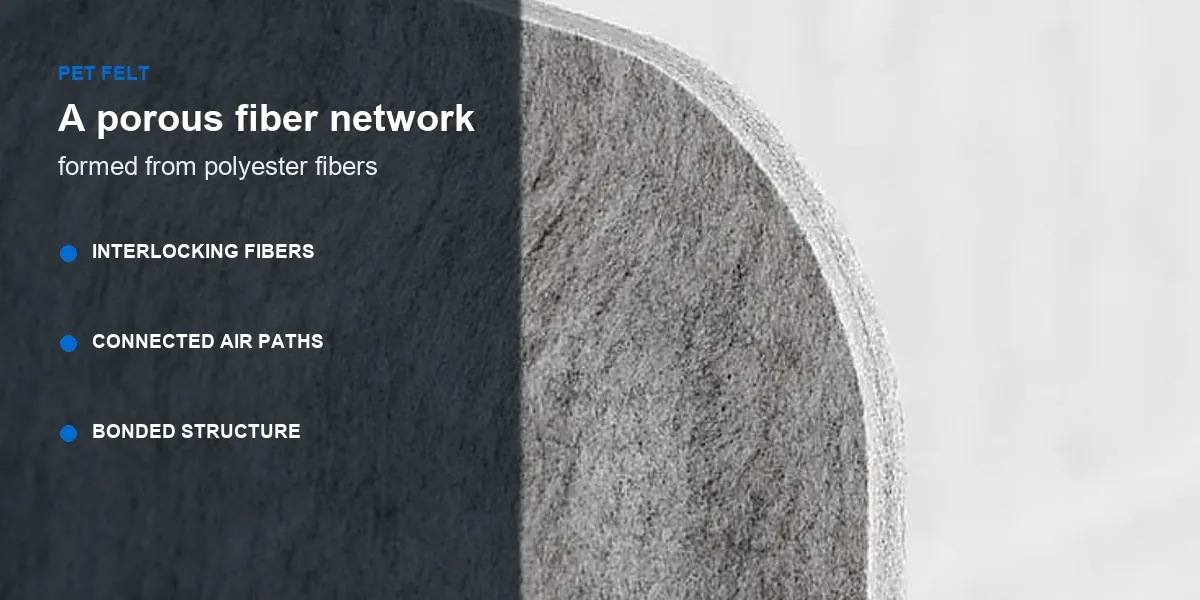
PET acoustic felt is usually made of polyester fibers that are formed into a porous fiber network through needle punching, heat pressing or other mechanical methods. Different raw material ratios, fiber fineness, density and forming processes will affect the structure, appearance and acoustic performance of the material.
- Fiber production — PET polymer is melt-extruded into filaments
- Web formation — the fibers are laid into a nonwoven felt layer
- Bonding — the fibers are secured by mechanical needling, thermal bonding, or a combination of both
- Recycled content
Many PET acoustic felt products use post-consumer recycled PET, but the percentage varies with feedstock, color, and formulation. Procurement decisions should rely on documentation for the specific product, such as a supplier declaration, third-party certification, or batch record. General industry ranges and “bottles per panel” conversions should not be presented as Feltlite product data.
Key Distinction: PET Acoustic Felt vs. Other Materials
PET acoustic felt is essentially different from the following materials:
| Material | Acoustic Mechanism | Key Characteristics |
|---|---|---|
| PET acoustic felt | Porous fiber network | Nonwoven fiber structure, typically mechanically bonded or thermally formed |
| Foam | Open-cell pore structure | Chemically foamed material with a relatively uniform cell structure |
| Fiberglass | Fibrous absorption | Usually requires a facing or fabric wrap |
| Mineral wool | Fibrous absorption | Made from stone or slag fibers; typically requires containment or a facing |
| Textile fabric | Thin woven or knitted structure | Limited thickness and generally limited absorption when used alone |
These materials should not be grouped together simply as “soft absorbers.” They differ substantially in absorption mechanism, fire behavior, construction, and suitable applications.
How Does PET Acoustic Felt Absorb Sound?
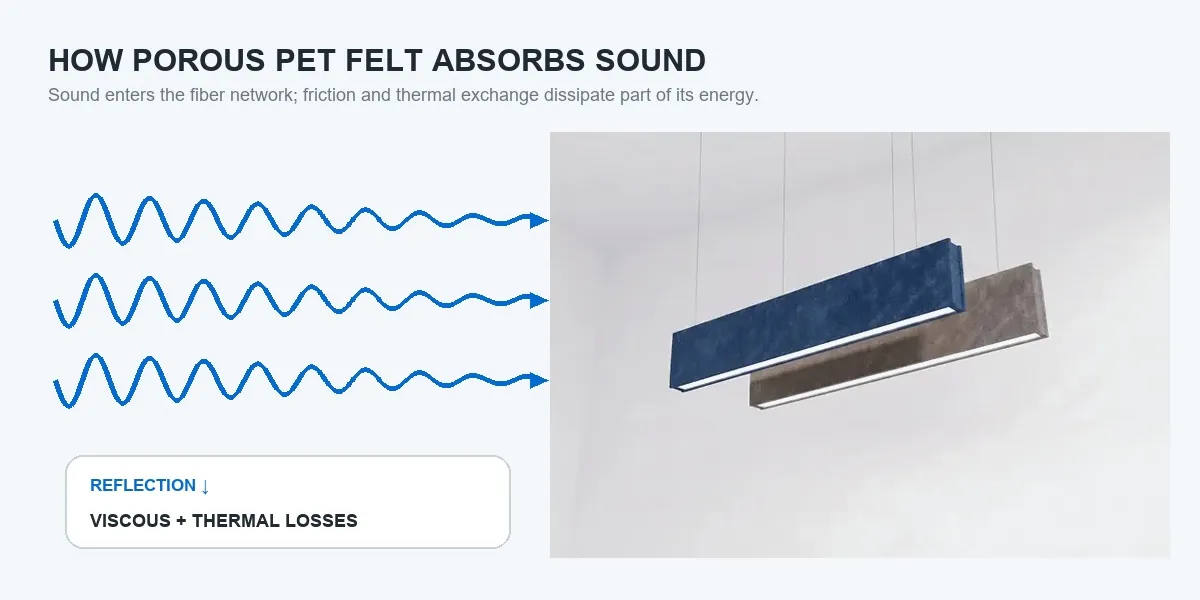
The process can be understood through the following physical mechanisms:
Mechanism 1: Porous Absorption
When sound reaches the surface of PET acoustic felt, it is not simply “bounced away” or “trapped.” Part of the incident sound energy enters the material’s porous structure. Surface impedance influences how much energy enters the material and how much is reflected back into the room.
Mechanism 2: Viscous Losses
Inside PET acoustic felt, sound causes air particles to oscillate through interconnected pores and fiber channels. The fibers create a tortuous path, so air does not travel straight through the material.
Mechanism 3: Thermal Dissipation
As air particles pass through these channels, two main loss mechanisms occur:
- Viscous losses — friction between moving air and fiber surfaces converts acoustic energy into heat
- Thermal losses — compression and rarefaction of air within the pores creates heat exchange with the fibers
These losses occur throughout the material volume. Sound energy does not disappear; a small portion is converted into heat.
Mechanism 4: Frequency Dependence
The result is less reflected sound and lower reverberant energy in the room, which may reduce RT60 (reverberation time).
Room RT60 depends on room volume, total absorption across all surfaces, furnishings and occupants, and the installed construction—not on the NRC of a single PET felt panel. A high-NRC material may still fail to achieve the target RT60 if too little is installed, while a moderate-NRC material may perform well when sufficient area is properly configured.
Related Reading: NRC vs. RT60: How to Evaluate Acoustic Performance
What Is the Sound Absorption Coefficient?

The sound absorption coefficient, α(f), is a fundamental measure of an acoustic material’s performance. At a given frequency, it is the ratio of sound energy absorbed by the material to sound energy incident on its surface.
At frequency f: α(f) = sound energy absorbed by the material ÷ sound energy incident on the material surface.
The absorption coefficient is frequency-dependent. A material does not have one universal “absorption percentage”; its performance varies across the spectrum. Test reports commonly provide coefficients at the following octave-band center frequencies:
- α₁₂₅ – 125 Hz (low frequency)
- α₂₅₀ – 250 Hz
- α₅₀₀ – 500 Hz
- α₁₀₀₀ – 1000 Hz
- α₂₀₀₀ – 2000 Hz
- α₄₀₀₀ – 4000 Hz (high frequency)
No material has one universal “sound absorption rate.” When a project requires more than a single-number rating, evaluate the frequency-specific data.
What Is NRC, and What Does It Tell You About PET Acoustic Felt?

The Noise Reduction Coefficient (NRC) is a single-number rating used in ASTM C423. It is generally calculated from the arithmetic average of the absorption coefficients at 250, 500, 1000, and 2000 Hz, then rounded to the nearest 0.05 in accordance with the standard. If another test standard or rating is used, identify it clearly in the specification to avoid mixing unlike values.
NRC is useful for:
- Quick comparisons between materials
- Preliminary material screening
- General specifications for noncritical applications
NRC does not show:
- The full frequency response
- Room RT60 (room-level reverberation time)
- Installed product performance, which is affected by mounting method, air gap, and geometry
- Speech intelligibility, which depends heavily on mid-frequency behavior and room conditions
- Low-frequency performance below 250 Hz, which is outside the NRC calculation
For example, a material can have a high NRC while providing limited absorption at 125–250 Hz. If a project must control low-frequency HVAC noise or sound-system bass, review the complete frequency-specific absorption data and the corresponding mounting conditions—not NRC alone.
How Does PET Felt Thickness Affect Sound Absorption?


Thickness is one of the most discussed—and most misunderstood—variables in acoustic felt specifications.
9 mm PET Acoustic Felt
Thinner PET acoustic felt, such as 9 mm material, generally provides effective absorption in the mid- and high-frequency ranges. Typical applications include:
- Reducing speech-related echoes
- Improving speech clarity in offices and conference rooms
- Applications with limited available space
12 mm PET Acoustic Felt
Increasing the thickness of a porous absorber generally helps extend absorption toward lower frequencies because sound travels through a deeper fiber structure, providing more volume for viscous and thermal energy losses. The degree of improvement still depends on airflow resistance, thickness, the cavity behind the material, and frequency.
Important: absorption does not increase in direct proportion to thickness. Doubling the thickness does not double NRC; the relationship is nonlinear.
What Is the Difference Between 9 mm and 12 mm PET Acoustic Felt?
Note: The following values are general industry references. Project decisions should be based on test reports for the specified manufacturer and product.
| Parameter | 9 mm PET Acoustic Felt | 12 mm PET Acoustic Felt |
|---|---|---|
| Thickness | 9 mm; tolerance per product specification | 12 mm; tolerance per product specification |
| Typical density | Refer to the technical data sheet for the specific model | Refer to the technical data sheet for the specific model |
| Areal density | Refer to the technical data sheet for the specific model | Refer to the technical data sheet for the specific model |
| NRC without an air gap | Use the report for the applicable mounting condition | Use the report for the applicable mounting condition |
| NRC with an air gap | Use the report for the stated air-gap depth | Use the report for the stated air-gap depth |
| Fire classification | Use the complete report for the specific product | Use the complete report for the specific product |
| Test method | Identify ASTM C423 or ISO 354 and the reported rating | Identify ASTM C423 or ISO 354 and the reported rating |
Source: General industry data. Values vary by manufacturer and product formulation.
Feltlite offers PET acoustic lighting products in multiple thicknesses and configurations, with customization available for OEM and project requirements. Select products using the technical specifications and test reports for the applicable model.
Does Higher-Density PET Acoustic Felt Absorb More Sound?

This is one of the most common technical questions, and the answer is not a simple “yes.”
Density affects:
- Airflow resistance — higher density generally creates greater resistance to airflow
- Pore structure — fiber packing changes pore size and connectivity
- Acoustic impedance — how well the material’s impedance matches that of air
- However, higher density does not guarantee better absorption at every frequency.
- Low density — air passes through too easily, producing limited viscous losses and lower absorption
- Moderate density — can provide an effective balance between airflow and energy dissipation
- Very high density — excessive airflow resistance may cause more sound to reflect from the surface rather than enter the material
- Airflow resistivity is a more precise parameter. It describes resistance to airflow per unit thickness. Effective performance generally occurs within an optimum range; values that are too low or too high can reduce absorption.
The density and areal density of PET acoustic felt vary with thickness, fiber structure, and formulation. Compare products using the same measurement basis and rely on the technical data sheet and test report for the specific model. General industry ranges should not be presented as fixed Feltlite specifications.
Why Does an Air Gap Matter?

An air gap is the distance between PET acoustic felt and a rigid boundary such as a wall or ceiling. For porous absorbers, an appropriately sized air gap can improve mid- and lower-frequency performance, although the result depends on material thickness, airflow resistance, cavity depth, and mounting method.
How it works:
- The air gap changes the absorber’s position relative to the sound field and rigid boundary, placing it closer to regions of higher particle velocity and potentially increasing energy dissipation in some mid- and lower-frequency bands. An ordinary porous PET felt assembly should not be described broadly as a “mass-spring system”; that model is appropriate only for clearly defined membrane or panel resonators.
- Sound can travel through the absorber, reflect from the rigid boundary, and pass through the material again
- The effective acoustic path through the absorber increases
- When the material and mounting conditions are properly matched, an air gap often improves mid- and lower-frequency absorption
Illustrative performance comparison:
| Mounting Method | 9 mm NRC | 12 mm NRC |
|---|---|---|
| Direct-mounted to a wall | Do not use a generic estimate; cite a test report | Do not use a generic estimate; cite a test report |
| 50 mm air gap | Use results for this mounting configuration | Use results for this mounting configuration |
| 100 mm air gap | Use results for this mounting configuration | Use results for this mounting configuration |
Source: General industry data.
In some tested configurations, thinner material with a suitable air gap may outperform thicker material mounted directly to a rigid surface in certain frequency bands. Because results depend heavily on the product and mounting conditions, specifications should identify material thickness, air-gap depth, mounting method, and test basis. An illustrative comparison should not be treated as a universal rule.
Suspended acoustic lighting often creates a gap between the felt and ceiling while increasing the material’s exposed area. Its acoustic contribution should be evaluated using the luminaire geometry, array spacing, and test data for the complete product or specified array.
Flat Panels, Folded Elements, and Three-Dimensional Forms


Geometry can substantially change acoustic performance. The same PET acoustic felt behaves differently in different configurations:
| Configuration | Construction | Acoustic Effect |
|---|---|---|
| Flat panel | Primarily one exposed face; wall- or ceiling-mounted | Absorption is mainly through the front face and edges, depending on mounting |
| Folded or formed felt | More material surface area within the same projected footprint | May increase total absorption per unit of projected area |
| Suspended baffle | Vertical element with both faces and edges exposed | Increases exposed area; total absorption cannot simply be assumed to double |
| Box or cavity form | Closed or semi-enclosed construction | Combines porous absorption with a cavity effect; any resonance must be verified |
| Acoustic luminaire | LED lighting integrated with felt geometry | Provides both lighting and sound absorption |
Why geometry matters:
- Exposed area — more exposed acoustic felt can provide greater total absorption
- Two-sided exposure — suspended baffles can interact with sound on both faces
- Air cavity — geometry can incorporate an air gap or internal cavity
- Angle of incidence — the direction of incoming sound affects interaction with the material
- Mounting method — suspended and surface-mounted installations create different boundary conditions
Feltlite acoustic blade products integrate vertical PET felt elements with lighting, increasing exposed absorption area without using additional wall space. Any claimed improvement in mid- or lower-frequency performance should be supported by laboratory data for the complete luminaire or specified array under the relevant mounting conditions.
How Does PET Acoustic Felt Perform at Different Frequencies?

Sound energy is not distributed uniformly across the spectrum. Different frequency ranges are associated with different sources and require different treatment strategies.
| Frequency Range | Common Sources | Absorption Challenge |
|---|---|---|
| Low frequency, below 250 Hz | HVAC rumble, traffic noise, sound-system bass | Usually the most difficult range; may require greater thickness, an air gap, or another verified assembly |
| Mid frequency, 250–2000 Hz | Speech, office activity, footsteps | Critical to speech clarity; PET felt often performs well in this range |
| High frequency, above 2000 Hz | Speech detail, sharp reflections, some equipment noise | Generally easier for porous materials to absorb |
The categories below are general guidance, not absolute boundaries. HVAC systems can also produce mid- and high-frequency noise, while speech energy spans the midrange and extends into higher frequencies.
When a single-number rating is not sufficient, review absorption data for each frequency band. In spaces with significant low-frequency HVAC noise, focus on the low-frequency results. In conference rooms and other speech-critical spaces, evaluate mid-frequency absorption together with coverage area and target RT60.
How Does PET Acoustic Felt Compare with Other Acoustic Materials?


Different materials suit different applications:
| Material | Acoustic Mechanism | Weight | Design Flexibility | Surface Finish | Typical Applications |
|---|---|---|---|---|---|
| PET acoustic felt | Porous fiber absorption | Light | High: can be cut, folded, thermoformed, and produced in many colors | Can remain exposed as a decorative finish | Offices, hospitality, education, and acoustic lighting |
| Fiberglass | Fibrous absorption | Moderate | Limited; usually requires wrapping | Typically fabric-wrapped | Concealed acoustic layers and high-performance wall systems |
| Mineral wool | Fibrous absorption | Heavy | Limited; usually requires containment | Fabric-wrapped or concealed | High-performance ceiling and wall systems |
| Foam | Open-cell absorption | Very light | Moderate | Often exposed with an open-cell surface | Studios and temporary acoustic treatments |
| Perforated metal with backing | Resonant and porous absorption | Heavy | Moderate | Industrial or architectural finish | High-durability, high-traffic areas |
Key differentiators:
- Sustainability — many PET acoustic felt products contain recycled material and may be recyclable
- Health and indoor environment — verify VOC emissions, fiber release, chemical content, and applicable certifications for the specific product
- Installation — lightweight, easy to cut, and easy to install
- Design — available in a wide range of colors, textures, and three-dimensional forms
- Fiberglass and mineral wool can provide strong broadband absorption and are often well suited to assemblies with greater low-frequency requirements. PET acoustic felt offers advantages in low weight, visible design applications, fabrication flexibility, and maintenance. Selection should be based on project goals rather than a blanket claim that one material is “better.”
To learn more about Feltlite PET acoustic materials and acoustic lighting, visit feltlite.com and request model-specific technical data and test documentation from the technical team.
Is PET Acoustic Felt Fire-Resistant? How to Read Fire Ratings Correctly

Fire performance is a critical requirement for commercial projects in North America and Europe and must be stated precisely.
PET Is Not Inherently Noncombustible
PET is a thermoplastic polymer. Under certain conditions, it can melt and may contribute to combustion. Fire performance depends on:
- Material formulation — the effect of additives and treatments
- Thickness — different thicknesses may perform differently
- Processing method — flame-retardant additives or coatings
- Assembly — mounting method, including mechanical fasteners or adhesive
- Test method — different standards use different classifications
Common fire-test standards referenced for PET acoustic felt include:
| Standard | Region | What It Evaluates | How Results Are Reported |
|---|---|---|---|
| ASTM E84 | North America | Surface-burning characteristics of building materials | Classification depends on the specific product and report |
| EN 13501-1 | Europe | Reaction-to-fire classification of construction products | Classification depends on the specific product, assembly, and end use |
| EN 1021-1 | Europe | Ignitability of upholstered furniture by a smoldering cigarette | Use only when the product falls within the standard’s upholstered-furniture scope |
Typical fire-rating language used for PET acoustic felt:
- ASTM E84 evaluates the surface-burning characteristics of building materials. A “Class A” claim must be supported by a complete report for the specific product, specimen thickness, and mounting method.
- EN 13501-1 classifies the reaction to fire of construction products. A rating such as B-s1,d0 may be cited only within the scope of the specific product, intended end use, and applicable classification report.
- Some products may achieve B-s2,d0, which indicates a higher smoke classification than s1.
Every fire rating must correspond to the specific product, thickness, formulation, substrate, mounting method, and end use. Specifications should reference the complete report rather than quoting the classification alone.
Material Testing and Complete Luminaire Compliance Are Not the Same
This distinction is essential:
- PET felt material testing — evaluates the felt itself under defined conditions
- Luminaire electrical certification — evaluates the electrical safety of the complete luminaire, including LEDs, drivers, wiring, and enclosure
- Project compliance — includes material requirements, luminaire and mounting requirements, and applicable building regulations
- A PET felt material classified as EN 13501-1 B-s1,d0 does not automatically mean that:
- The complete luminaire is fire-rated
- The luminaire has passed electrical safety certification such as CE or UL
- The installed assembly meets all project fire and building-code requirements
- The rating applies to every color, thickness, or batch
Feltlite can provide applicable fire-test documentation for specific products and projects. Confirm the covered model, thickness, mounting configuration, and scope with the technical team.
Is PET Acoustic Felt Sustainable? Which Documents Should You Verify?
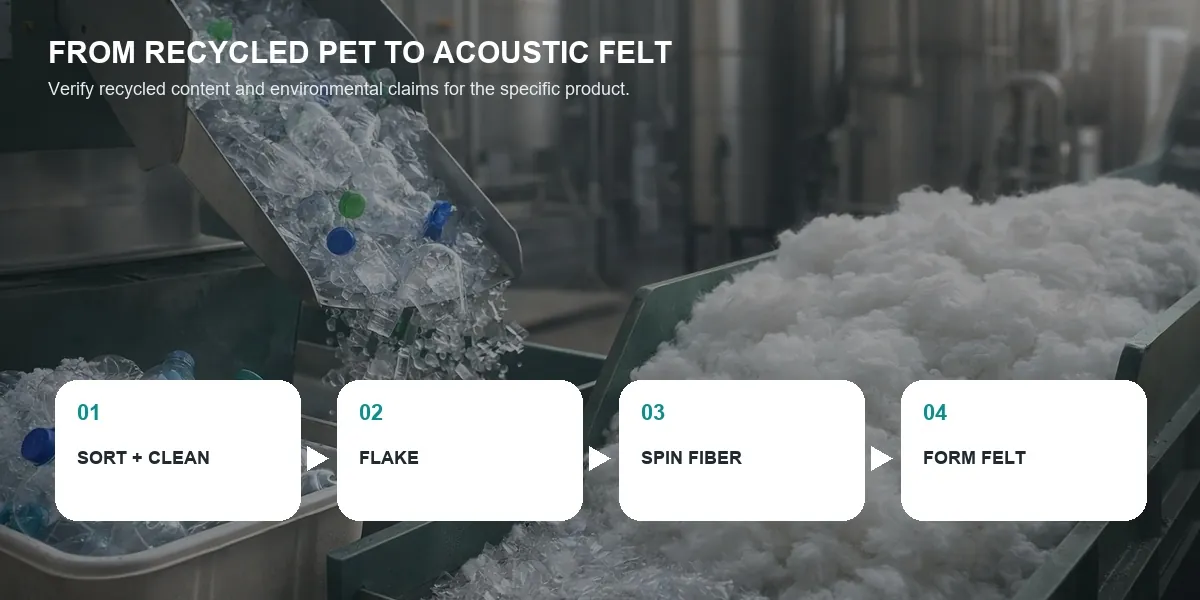
Sustainability is often oversimplified. In B2B technical communication, claims should be specific, measurable, and supported by documentation.
Recycled content:
- Recycled content must be verified for the specific product using supplier declarations or third-party documentation.
- If a project requires a specified recycled percentage, state the minimum percentage, calculation method, and required verification documents.
- PET fibers may be recyclable, but actual recyclability depends on the local recycling infrastructure and any laminates or surface treatments.
VOC emissions:
PET acoustic felt may have low VOC emissions, but the material name alone is not evidence. Review a third-party emissions report for the specific product.
- Green building programs such as LEED may require compliance with specified low-emitting-material test methods and documentation. The project team should determine whether a product contributes to a credit based on the product documentation and the version of the rating system being used.
- Relevant documents may include reports or certifications under CDPH Standard Method, GREENGUARD, or OEKO-TEX STANDARD 100. These programs evaluate different attributes and are not interchangeable; a certificate for one product also cannot be generalized to all PET products.
- Durability — PET acoustic felt can remain dimensionally stable and retain its acoustic function over time when properly specified and installed. Any specific durability claim should be supported by product documentation.
- Recyclability — PET acoustic felt may be recyclable at end of life, but actual recovery depends on local recycling systems and whether the product includes laminates or coatings.
Color, Batch Variation, and Physical Sample Approval


Color and finish are often treated as purely aesthetic considerations, but they also have technical implications in a specification.
- Color consistency — variations may occur between batches; color-critical projects should use approved physical samples
- Batch variation — even products with the same color code may vary slightly between production runs
- Screen image vs. physical sample — on-screen color must not be used for final approval
- Lighting conditions — color appearance changes under daylight, warm-white LEDs, and cool-white LEDs
- Texture — surface texture affects appearance and may also influence acoustic performance
- Edge treatment — cut, folded, or finished edges affect appearance and durability
- Important specification note: For color-critical projects, approve color using a physical sample rather than a screen image. Feltlite can provide physical color swatches for project approval.
Cutting, Forming, and Manufacturing Tolerances
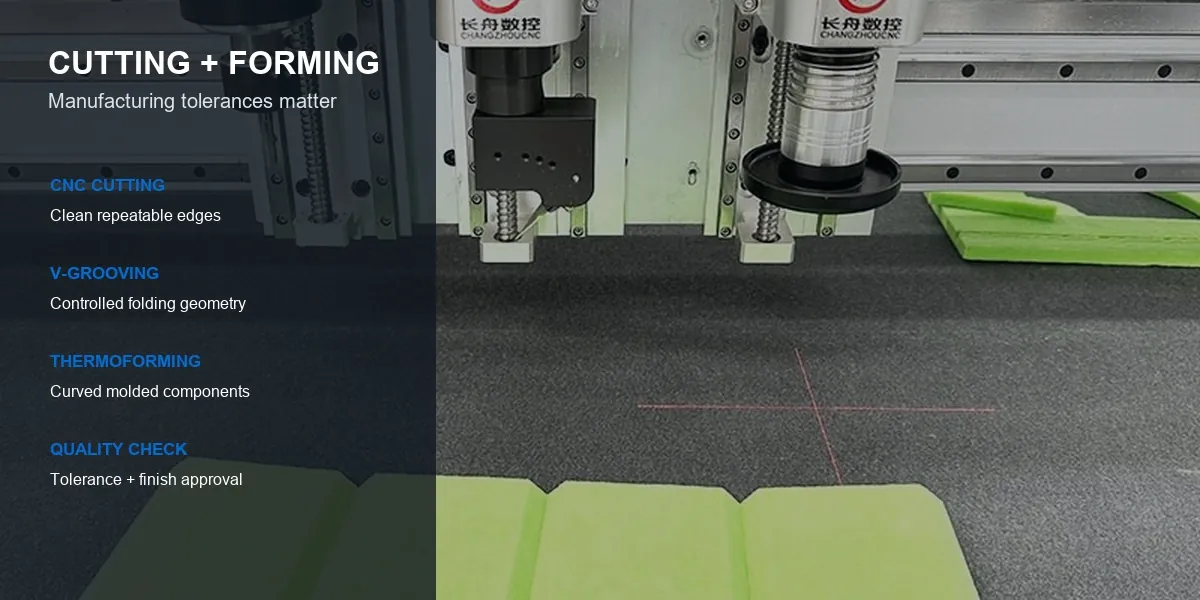
Manufacturing capability is an important part of Feltlite’s value. Available processes include:
- CNC cutting — precision cutting of flat sheets into custom shapes and sizes
- Die cutting — repeatable shapes for volume production, where applicable
- V-grooving and folding — grooved felt can be folded into three-dimensional forms
- Thermoforming or hot pressing — heat and pressure are used to create curved or molded components
- Lamination — combining acoustic felt with other materials, where applicable
Quality considerations:
| Factor | Specification Consideration |
|---|---|
| Edge quality | Clean cuts affect appearance, durability, and installation quality |
| Dimensional tolerance | State tolerances for thickness and complex shapes in manufacturing drawings and approved samples |
| Perforations | Hole size, pattern, and spacing may affect both acoustic and visual performance |
Cutting and forming can affect acoustic performance. Test data for flat material may not apply to a formed or extensively cut product. Projects with strict acoustic requirements should use data for the final product configuration whenever possible.
Feltlite supports custom PET acoustic felt fabrication for OEM and project requirements.
How Is PET Acoustic Felt Used in Acoustic Lighting?

Acoustic Linear Pendant Lights
PET acoustic felt forms the acoustic body of the luminaire. The felt surrounds or integrates with the LED light source, providing illumination and absorption in one product.
Acoustic Blades
Vertically suspended acoustic felt elements offer several benefits:
- Increased exposed surface area
- Interaction with sound on both faces
- Visual rhythm and spatial definition
Acoustic Baffle and Enclosure Lights
Three-dimensional acoustic felt constructions can:
- Increase exposed area through geometry
- Create an internal air cavity
- Combine porous absorption with a designed cavity to address target frequency ranges. If the design relies on resonance, verify performance through calculation, prototype testing, or a complete product report.
Acoustic Panel Pendant Lights
Flat or formed acoustic felt panels can be suspended and combined with:
- Direct and indirect lighting
- Single- or double-sided exposure
- Architectural design features
Components: PET acoustic felt (absorption) + aluminum frame (structure) + LED light engine (illumination) + diffuser (light distribution) + driver (power) + suspension system (mounting)
How Should Commercial Projects Select and Specify PET Acoustic Felt?

Architects and specifiers should not simply write “acoustic PET felt” in a product schedule. A complete specification should include the following information:
| Specification Item | Information to Include |
|---|---|
| Material type | PET acoustic felt, polyester fiber, nonwoven construction |
| Thickness | 9 mm, 12 mm, or custom thickness |
| Density | kg/m³ or g/m², with the basis relevant to performance |
| Color | Color code plus physical-sample approval |
| Acoustic test | Test standard, rating, specimen dimensions, and mounting conditions |
| Fire test | Test standard, classification, report scope, and end use |
| Mounting | Direct-mounted, suspended, baffle, or stated air-gap depth |
| Exposed area | Total exposed surface area after installation |
| Geometry | Flat, folded, baffle, box, or custom form |
| Edge finish | Cut, folded, finished, or trimmed edges |
| Tolerance | Thickness and cut-dimension tolerances |
| Recycled content | Minimum percentage, calculation method, and verification documents |
| VOC and environmental documentation | Required tests, certifications, and scope |
| Batch and sample approval | Physical sample and color-batch approval before production |
Specification Table Template
| Parameter | Example Requirement | Verification Method |
|---|---|---|
| Material | PET acoustic felt; recycled-content requirement aligned with product documentation | Supplier declaration or third-party documentation |
| Thickness | 12 mm; tolerance per manufacturer’s specification | Physical measurement and technical data sheet |
| Acoustic performance | Specify frequency-specific data or NRC and state the mounting condition | Complete laboratory test report |
| Fire performance | Classification required by local regulations and intended end use | Complete test and classification report |
| VOC emissions | Requirement based on the project’s selected low-emitting-material method | Third-party test report |
| Color | Specified color code approved by physical sample | Physical sample |
| Mounting | Suspended; state air gap and array spacing | Shop drawings and installation instructions |
This format can be incorporated directly into project documents.
Common Specification Mistakes
Mistake 1: Comparing NRC values without checking the test conditions.
Different laboratories, mounting methods, and test standards can produce different results.
Mistake 2: Assuming thicker material is always proportionally better.
The relationship is nonlinear; doubling thickness does not double NRC.
Mistake 3: Ignoring frequency-specific data.
NRC alone does not reveal low-frequency performance.
Mistake 4: Ignoring mounting method and air gap.
An air gap may improve absorption in some frequency bands, but the degree of improvement depends on the material and test configuration. One sample data set should not be treated as a universal rule.
Mistake 5: Treating material NRC as room RT60.
Room acoustics depend on total installed absorption and room volume, not on material NRC alone.
Mistake 6: Treating a material fire rating as luminaire certification.
Material fire testing and complete luminaire certification are separate requirements.
Mistake 7: Approving color from a screen image alone.
Color-critical projects require a physical sample.
Mistake 8: Comparing price without checking density and specifications.
A lower price may indicate a different density, thickness, or acoustic performance.
How to Read a Sample Acoustic Data Set
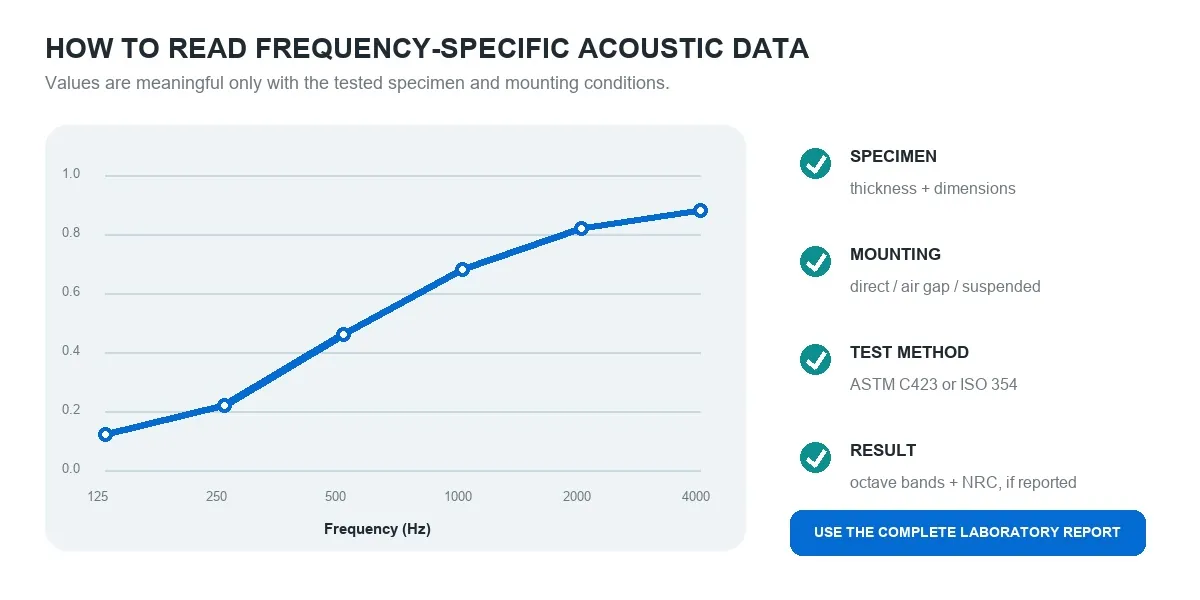
Note: The following table demonstrates how to read frequency-specific test data. It does not represent Feltlite product performance. Final product selection must cite the specific model, specimen construction, mounting method, and laboratory report.
Example specimen: 12 mm PET acoustic felt
Example test: reverberation-room sound absorption test
Example mounting: suspended construction with an air gap
| Frequency (Hz) | Sound Absorption Coefficient, α |
|---|---|
| 125 | Illustrative value removed; insert data from the applicable product report |
| 250 | Illustrative value removed; insert data from the applicable product report |
| 500 | Illustrative value removed; insert data from the applicable product report |
| 1000 | Illustrative value removed; insert data from the applicable product report |
| 2000 | Illustrative value removed; insert data from the applicable product report |
| 4000 | Illustrative value removed; insert data from the applicable product report |
NRC and the absorption coefficient in each frequency band must come from the applicable test report. This example does not provide product values suitable for direct use in a specification.
When reviewing results, consider the 125–4000 Hz frequency bands, specimen area, edge treatment, and mounting configuration. If the project has significant low-frequency requirements, consider thicker material, an appropriate air gap, a composite assembly, or another verified low-frequency treatment.
The results apply only to the tested specimen and mounting conditions. They do not mean that every PET acoustic felt product or room will perform the same way. Always use test data for the specified product.
Conclusion
Do not evaluate PET acoustic felt by thickness, density, or NRC alone. A reliable selection process reviews material properties, frequency-specific absorption data, mounting configuration, coverage area, target RT60, fire documentation, and indoor environmental documentation within one technical framework.
A complete evaluation should also consider:
- Material — fiber composition, recycled content, and bonding method
- Frequency — differences in absorption across frequency bands
- Construction — thickness, density, geometry, and edge treatment
- Mounting — direct-mounted, air gap, suspended, or baffle
- Area — the relationship between total installed absorption and room volume
- Room — volume, boundary surfaces, and existing acoustic conditions
For acoustic lighting, PET felt must also be coordinated with lighting performance, suspension structure, fire requirements, electrical certifications, and the overall project design. It is one component of an integrated system, not a stand-alone solution.
This guide is for general reference. For product-specific performance, consult the manufacturer’s technical data sheet and test report. Acoustic performance should be verified for the selected product, mounting method, and room conditions.
FAQs
1. What is PET acoustic felt?
PET acoustic felt is a porous nonwoven material made from polyester (PET) fibers. Viscous and thermal losses within the fiber network dissipate part of the acoustic energy as minute amounts of heat.
2. How does PET acoustic felt absorb sound?
Sound enters the porous structure and causes air particles to move through the fiber channels. Friction between the air and fibers, together with thermal exchange, dissipates acoustic energy as minute amounts of heat.
3. Does thicker PET felt absorb more sound?
Usually, especially at lower frequencies, but the improvement is not proportional. Doubling thickness does not double NRC; the relationship is nonlinear.
4. What is the NRC of PET acoustic felt?
PET acoustic felt does not have one fixed NRC that applies to every product and mounting method. Values vary with thickness, density, specimen area, edge treatment, air gap, and test conditions. Use the complete report for the specific model and mounting configuration.
5. Does an air gap improve PET acoustic felt absorption?
It can. An air gap between PET acoustic felt and a rigid boundary can improve absorption, particularly at lower frequencies. The degree of improvement depends on the material and mounting configuration.
6. Is PET acoustic felt fireproof?
PET acoustic felt is not inherently noncombustible. Some specific products may achieve classifications under EN 13501-1 or ASTM E84, but the product model, thickness, mounting configuration, end use, and complete report must be verified.
7. How does PET acoustic felt differ from fiberglass?
PET acoustic felt is lightweight, design-flexible, and suitable as an exposed decorative finish. Fiberglass typically requires a facing or fabric wrap and is often used as a concealed absorption layer.
8. Does PET felt density affect sound absorption?
Yes, but higher density does not necessarily mean better absorption. Performance typically has an optimum density or airflow-resistivity range; values that are too low or too high can reduce absorption.