 English
 简体中文
 Deutsch
 Español
 Français
 Italiano
 日本語
 한국어
 Polski
 Português
 Русский
 Türkçe
 Nederlands
 ไทย
 Tiếng Việt

When selecting commercial light fixtures, it is easy to focus on shape, wattage, lumen output, or price. Those are important, but they are only part of the decision. Ceiling conditions, controls, glare, maintenance, architecture, and room acoustics can all affect whether a fixture is right for the project.
In an office, meeting room, hotel, restaurant, education space, or reception area, the lighting system has to work with the room rather than simply illuminate it. This guide focuses on design-led commercial interiors rather than high-bay, warehouse, parking-lot, or exterior lighting, because those projects are normally driven by a different set of requirements.
So when does a conventional commercial light fixture make more sense, and when is it worth choosing a fixture that also contributes to the acoustic environment?
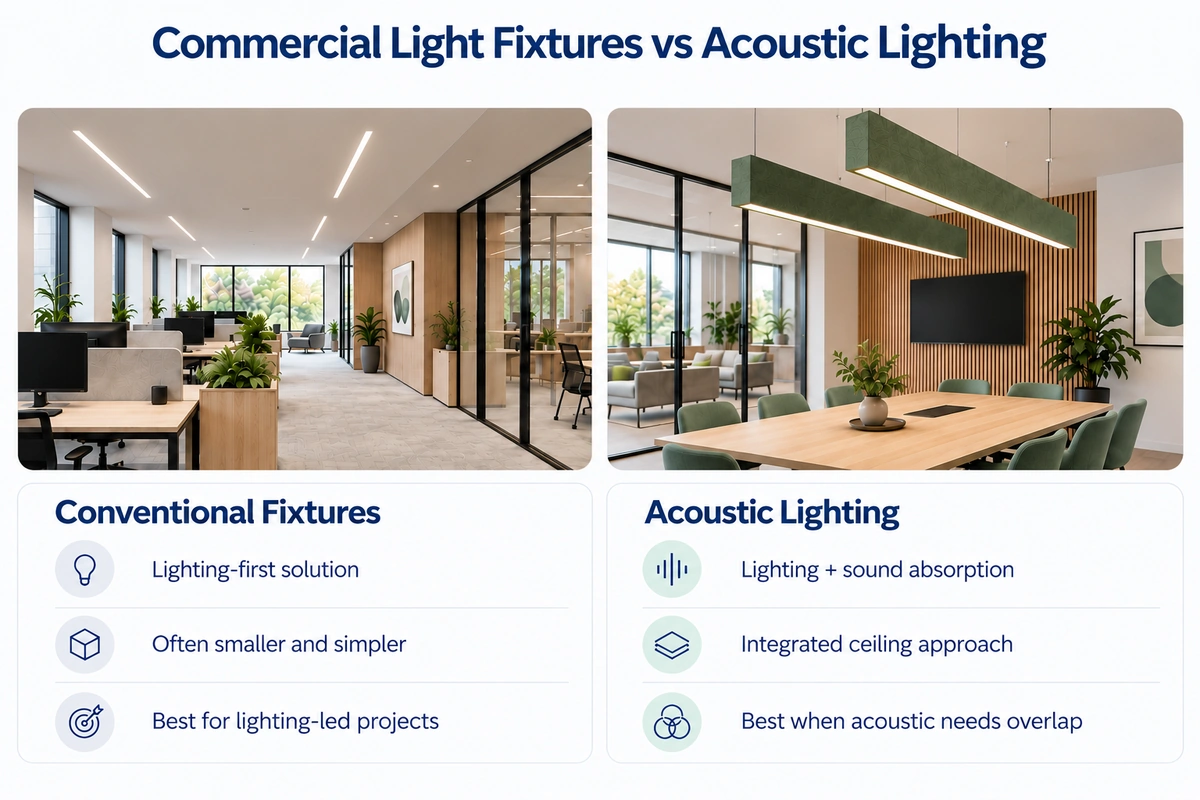
Quick Answer
Acoustic lighting is not a replacement for conventional commercial lighting. It makes the most sense when lighting demand, acoustic treatment, and the architectural ceiling intent overlap in the same area.
Conventional commercial fixtures may still make more sense when the project is primarily lighting-led, requires specialized optical performance or very high output, or has little need for additional acoustic treatment. The right choice depends on the complete project brief rather than the appearance of the fixture alone.
Three Common Roles Commercial Fixtures Can Play
“Commercial light fixture” is a broad term that can cover many types of luminaires used in non-residential interiors, from recessed and surface-mounted fixtures to pendants, linear luminaires, downlights, and architectural lighting.
For this discussion, it is more useful to look at the role a fixture plays in the project rather than treat these as rigid product categories. In design-led commercial interiors, fixtures commonly serve three roles: functional lighting, architectural or decorative lighting, and acoustically integrated lighting.
Functional Fixtures
Functional commercial fixtures are generally selected around the lighting task first. Recessed and surface-mounted fixtures are often used when the lighting system needs to remain visually quiet, while suspended linear fixtures can work well above long workstations, corridors, and conference tables. Many commercial LED fixtures use these same familiar formats, but the light source does not remove the need to evaluate distribution, glare, mounting, controls, and serviceability.
Architectural and Decorative Fixtures
Pendant, ring, linear, and custom-form architectural light fixtures can become part of the visual language of a commercial interior. In these applications, form, scale, material, and repetition can influence how the space is perceived. Custom lighting design becomes relevant when a standard product cannot resolve the required scale, geometry, finish, or brand expression.
Integrated Acoustic Lighting
Acoustic lighting sits between functional, architectural, and integrated commercial lighting. It still needs to perform as a commercial luminaire, but it also introduces sound-absorbing PET felt into the fixture.
The category includes panel, ring, linear, dome, felt shade, EchoSlice, and baffle formats. You can explore the full range of acoustic lighting solutions and compare them by form, lighting role, acoustic contribution, and layout.
These categories can overlap. A suspended linear luminaire, for example, may be functional, architectural, and acoustically integrated at the same time.
Commercial Light Fixtures Should Be Selected by Application, Not Appearance
The better sequence is to start with the space, understand the task, and then select the fixture. A product that works well in one room may be inappropriate in another even when the ceiling height and visual style look similar.
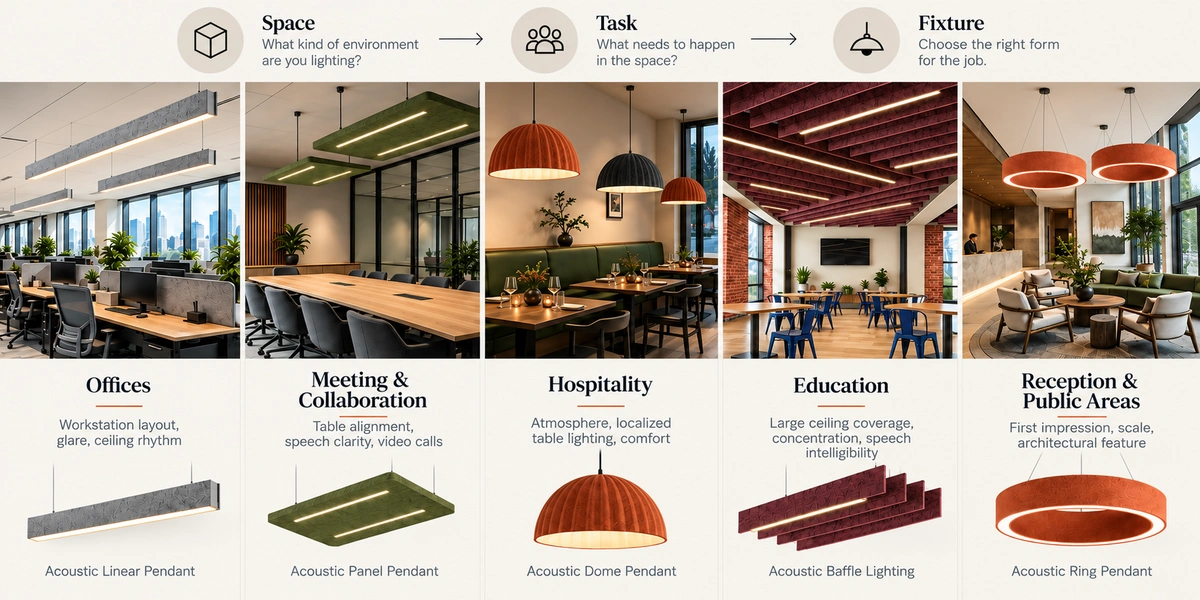
Offices
Open offices need to balance workstation layout, glare, ceiling height, repeated fixture placement, and acoustic comfort.
A suspended linear fixture can work well when lighting needs to follow workstation rows. If the same ceiling area also needs acoustic treatment, acoustic linear pendant lighting may be worth considering.
Meeting and Collaboration
Meeting rooms and collaboration spaces typically place more emphasis on speech clarity, video calls, glare, table alignment, and acoustic comfort.
A fixture above a meeting table needs to provide appropriate light where people are seated while fitting the visual and acoustic character of the room. In this context, an acoustic panel pendant light can be considered when a broad suspended surface and integrated illumination are useful.
Hospitality
Hotels, restaurants, lounges, and other hospitality interiors often balance atmosphere, visual identity, table lighting, sound comfort, and material or color.
For localized applications above tables or seating groups, acoustic dome pendant lights can be relevant because the deeper form brings focused illumination and feels closer to the occupied zone.
Education
Education spaces have to consider speech intelligibility, concentration, glare, large ceilings, and scalable coverage.
For larger ceiling fields, acoustic baffle lighting can be considered when the project needs organized illumination and additional vertical sound-absorbing surfaces.
Reception and Public Areas
Reception areas and other public spaces often carry more architectural responsibility. First impression, visual scale, brand identity, and the relationship between the ceiling and occupied zone can matter as much as basic illumination.
An acoustic ring pendant light can be relevant when the lighting element also needs to act as a visible architectural feature.
The Seven Performance Questions to Ask Before Selecting a Fixture
A fixture should only move forward if it satisfies the lighting task, visual comfort, controls, installation, and maintenance requirements. The first six questions apply to both conventional and acoustic luminaires. The seventh determines whether the lighting decision should also become an acoustic decision.
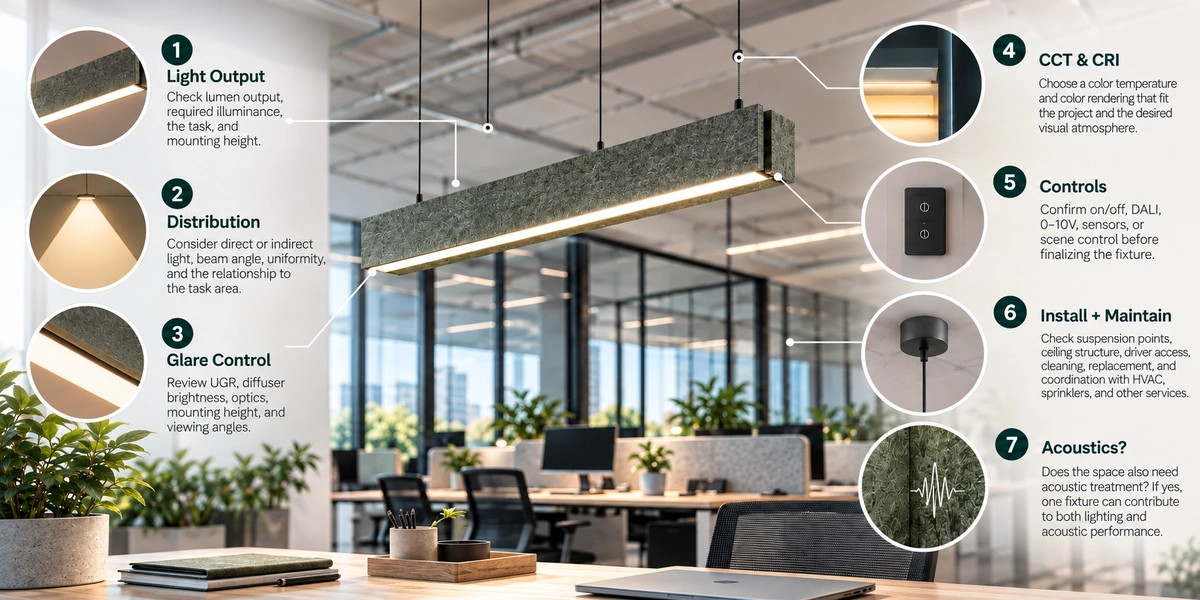
1. Does the Light Output Match the Task?
Do not select a fixture based on wattage alone. Review lumen output, required illuminance, the task being performed, and mounting height.
A decorative pendant above a lounge table and a fixture above a workstation may both provide light, but they do not necessarily have the same lighting requirements.
2. Does the Distribution Work?
Consider direct or indirect light, beam angle, uniformity, furniture layout, and the relationship between the fixture and the task area.
A fixture that is bright enough can still be wrong if the light is concentrated in the wrong place.
3. Is Glare Controlled?
Offices and meeting rooms need more than sufficient lumen output. Review UGR where it is relevant to the project, together with diffuser brightness, optics, mounting height, and viewing angles. Glare should be evaluated in the actual room layout, not inferred from lumen output alone.
4. Are CCT and CRI Appropriate?
Color temperature and color rendering should fit the project. Review CCT, CRI, color consistency, and the visual atmosphere required for the space.
5. What Controls Are Required?
Confirm the control strategy before the fixture is finalized. Depending on the project, this may include on/off, DALI, 0–10V, sensors, or scene control.
Changing the driver or control method late in the process can affect the product configuration, wiring, cost, and lead time.
6. How Will the Fixture Be Installed and Maintained?
Check suspension points, ceiling structure, driver access, cleaning, replacement, HVAC, sprinklers, access panels, and service clearance.
Commercial lighting cannot be evaluated only as a product. It has to work with the complete reflected ceiling plan and remain serviceable after installation.
7. Does the Space Also Need Acoustic Treatment?
This is the point where the lighting decision may become an acoustic decision as well.
If a ceiling area already needs suspended lighting and the room also has a meaningful acoustic requirement, it is worth asking whether one fixture can contribute to both functions.
For a deeper project-level framework, see how to choose acoustic lighting for commercial projects.
Conventional Commercial Fixtures — Where They Still Make More Sense
Acoustic lighting should solve a real overlap. It should not be added simply because it is available.
Spaces With No Meaningful Acoustic Requirement
If the room does not have a meaningful acoustic problem, adding an acoustic function may introduce cost, size, or coordination that the project does not need.
Specialized Optical Requirements
Some projects require very precise beam control, specialized optics, or highly controlled lighting performance. In those situations, a conventional commercial fixture designed around the optical task may be the more direct solution.
High-Output or Industrial Tasks
If the brief is primarily high-output, functional, or industrial in nature, acoustic lighting is not necessarily the natural choice. High-bay, warehouse, production, and other demanding task-lighting applications normally start from output, mounting height, environmental rating, and optical distribution rather than acoustic integration.
Existing Acoustic Ceiling Already Provides Sufficient Treatment
A room may already have an acoustic ceiling, wall panels, acoustic clouds, or other absorption. If the acoustic strategy is already sufficient, adding acoustic lighting may provide limited additional value.
Retrofit Projects Where Lighting Is the Only Scope
If an existing project is simply replacing lighting and the acoustic treatment has already been defined, changing the whole ceiling strategy may create unnecessary coordination.
When Acoustic Lighting Becomes a Better Commercial Option
The Space Has Hard Reflective Finishes
Glass, concrete, plasterboard, hard floors, and other reflective surfaces can contribute to reflected sound and reverberation.
Acoustic lighting can add sound-absorbing PET felt within the ceiling zone where lighting is already required.
Lighting and Acoustic Treatment Occupy the Same Ceiling Zone
If the project already needs lighting and acoustic treatment above the same workstations, meeting tables, collaboration areas, or public zones, integrating the two functions can simplify the ceiling composition.
Ceiling Visual Simplicity Is Important
Commercial ceilings often contain lighting, HVAC, sprinklers, sensors, speakers, and access requirements. Where the design also needs separate acoustic panels, the number of visible ceiling elements can increase.
Meeting, Collaboration, or Hospitality Zones Need Localized Treatment
The entire room does not necessarily need the same acoustic treatment. A project may need more support around a meeting table, collaboration zone, reception desk, or lounge.
Suspended Lighting Is Already Planned
If suspended lighting is already part of the project, acoustic lighting becomes a natural option to evaluate because the fixture can potentially contribute to both lighting and acoustic functions.
What Acoustic Lighting Adds Beyond Illumination
Acoustic Contribution
PET felt can absorb part of the reflected sound in a room. The actual contribution depends on exposed area, quantity, layout, suspension, orientation, and room conditions.
One fixture should not be presented as a complete acoustic solution for an entire room. Acoustic lighting addresses reflected sound inside the room; it is not soundproofing and does not stop sound transmission through walls, doors, floors, glazing, or ceilings.
For projects where acoustic performance needs to be calculated as part of the wider room strategy, see acoustic lighting and room acoustic requirements.

Visual Zoning
A suspended fixture can help define a meeting zone, reception area, dining area, or collaboration zone.
Ceiling Integration
Lighting, acoustic material, suspension, and ceiling services can be considered as one composition.
Material and Color
PET felt can participate in the interior design rather than being treated as a hidden technical material. Color, texture, form, and scale can influence the visual relationship between the fixture and the room.
Custom Form
Where a project requires a special dimension, geometry, color, or brand expression, acoustic lighting can become part of the architectural feature. The value of a custom form should still be judged against lighting performance, acoustic contribution, manufacturability, installation, and maintenance.
Commercial Light Fixtures vs Acoustic Lighting
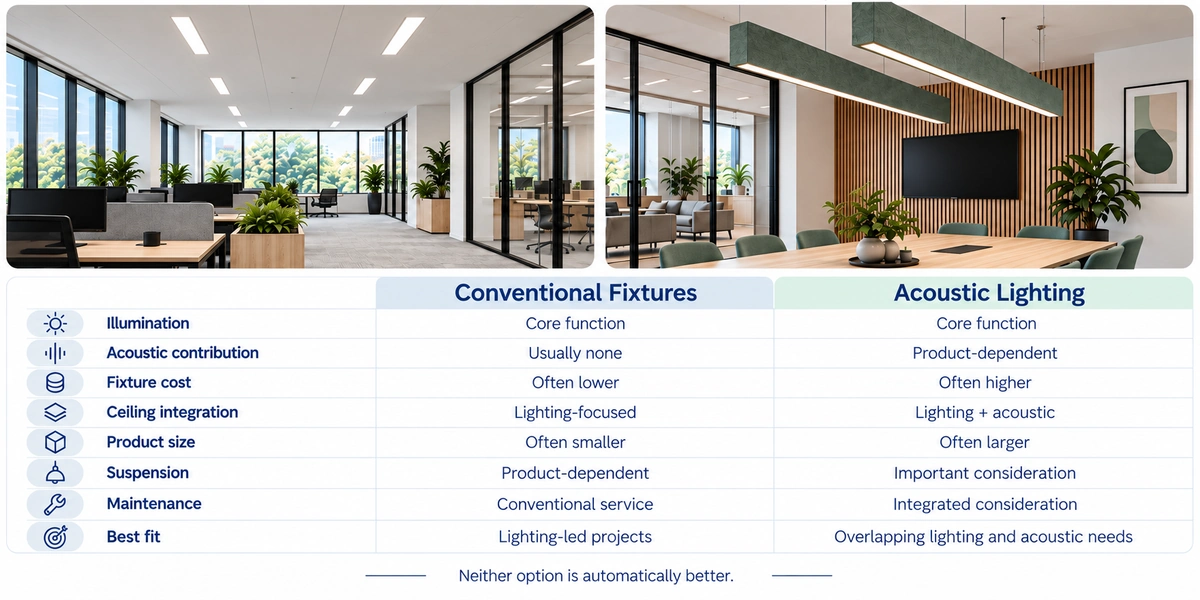
Neither option is automatically better. The better choice depends on what the project actually needs the ceiling to do.
Does Acoustic Lighting Cost More?
Acoustic lighting can have a higher fixture price than a conventional light because the product combines lighting and acoustic elements.
But fixture price alone does not show the total project cost.
A useful comparison should also consider separate acoustic treatment, suspension, installation, ceiling coordination, freight, maintenance, and technical documentation.
The more useful comparison is the total project scope, not simply the price of one fixture. For a deeper breakdown, see the Acoustic Lighting Cost Guide.
Standard Commercial Fixture or Custom Lighting Design?
Standard Fixtures
Standard fixtures are generally the simplest choice when the project has repeatable layouts, straightforward specifications, predictable quantities, and a need for cost and schedule control.
Configured Fixtures
A configured fixture keeps the core product platform but adjusts selected elements such as size, color, CCT, controls, or suspension. This approach can provide project-specific flexibility without the engineering scope of a completely new product.
Full Custom
Full custom becomes relevant when the project requires different dimensions, geometry, brand color, structure, output, or control configuration.
If the customer already has design drawings, brand requirements, or special spatial constraints, the project can move into a formal OEM/ODM development process. The Custom Acoustic Lighting Manufacturer: Complete OEM/ODM Guide explains the typical path from design review and engineering to sampling, approval, production, and delivery.
What Should Be Verified Before Specification?

Photometric Data
Check lumen output, CCT, CRI, beam angle, UGR, and IES/LDT files where required.
Do not rely only on product images or general marketing descriptions. Photometric data should match the actual model and configuration being specified.
Acoustic Data
For acoustic lighting, ask what was actually tested. Review the test object, configuration, exposed acoustic area, and mounting condition.
Material test data should not automatically be treated as the performance of a complete suspended fixture in the finished room.
Electrical and Controls
Confirm voltage, driver, DALI, 0–10V, dimming, emergency requirements, and any project-specific control protocol.
Fire and Compliance Documentation
Before approval, review the relevant acoustic lighting compliance requirements and confirm which documents apply to the project market and specification. A component certificate should not automatically be assumed to cover every finished fixture configuration; verify the scope of the documentation supplied.
Suspension and Structural Information
Confirm ceiling structure, suspension points, fixture weight, mounting method, cable length, and maintenance access.
Maintenance and Replaceable Components
Ask how drivers, LED components, diffusers, and other serviceable parts can be accessed or replaced. Also confirm cleaning requirements and spare-parts support.
Packaging and Delivery
Check packaging, freight, lead time, and site delivery. For commercial projects, delivery is part of the product scope; oversized fixtures, custom packaging, and phased site deadlines can affect the practical cost of a solution.
Application Scenarios — Which Fixture Strategy Fits?
This table is an early-stage decision guide, not an absolute specification rule.
| Scenario | Use acoustic lighting when… | Use separate lighting + acoustic treatment when… |
| Open office | Lighting and absorption are needed over the same workstation zones. | Acoustic treatment already exists or follows a different layout. |
| Meeting & collaboration | The table zone needs light, speech comfort, and one clear visual element. | The room needs broader treatment than the fixture area can provide. |
| Restaurant & hospitality | Localized absorption is useful over tables or seating, and the light is part of the design. | Treatment must cover wider ceiling or wall areas. |
| Education | Repeated lighting and absorption are both needed across teaching areas. | An acoustic ceiling already provides enough treatment. |
| Reception & public areas | A feature light can also add useful absorption in the focal zone. | Lighting is mainly decorative or treatment is needed elsewhere. |
| High acoustic requirement | As one contributing part of a wider acoustic strategy. | Dedicated panels, baffles, ceiling, or wall treatment are required. |
| Retrofit / existing lighting | Lighting is being replaced anyway, so integration is practical. | Existing lighting works; add acoustic treatment independently. |
The final choice still depends on the room, lighting requirements, acoustic requirements, ceiling conditions, and budget.
How Commercial Buyers Should Compare Two Quotations
When two quotations arrive, do not compare unit price first.
Compare the complete specification and supply scope:
| Item | What to Compare |
| Lighting | Lumen/output |
| CCT | Color temperature |
| CRI | Color rendering |
| Controls | DALI / 0–10V / On-Off |
| Acoustic | Acoustic data and test basis |
| Size | Dimensions |
| Suspension | Mounting and cable |
| Finish | PET color/finish |
| Certification | Certificates/reports |
| Warranty | Warranty terms |
| Incoterm | EXW / FOB / other |
| Freight | Shipping cost |
| Lead time | Production + delivery |
Two fixtures may look similar in a rendering and still represent very different specifications, delivery scopes, and project costs. A useful quotation comparison should make technical differences visible before the buyer compares the final price.
Conclusion
No single commercial light fixture is right for every project.
Conventional commercial fixtures remain a practical choice when lighting is the primary requirement, the optical task is specialized, or the space does not need additional acoustic treatment.
Acoustic lighting becomes more relevant when lighting, acoustic absorption, and ceiling design genuinely overlap.
The best choice is not the fixture with the most features. It is the fixture that fits the complete project brief.
If you are comparing commercial light fixtures for an office, hospitality, education, or other interior project, share your room requirements, ceiling conditions, and lighting brief with Feltlite. We can help evaluate the appropriate acoustic lighting configuration and technical requirements. Request a Project Quote
FAQ
Written by Stephen Lee
Content & Marketing SpecialistTechnical Review by Jacky Tang
Marketing Manager
Email: info@feltlite.com