 English
 简体中文
 Deutsch
 Español
 Français
 Italiano
 日本語
 한국어
 Polski
 Português
 Русский
 Türkçe
 Nederlands
 ไทย
 Tiếng Việt

Direct answer: Acoustic lighting performance should be evaluated at three levels. At the material level, use frequency-specific sound absorption coefficients and NRC. At the complete-fixture level, use equivalent sound absorption area. At the room level, use RT60 together with other metrics appropriate to the space. These data are related, but they are not interchangeable. In particular, the NRC of PET felt cannot be treated as the performance rating of a complete luminaire or as a room result.
A flat PET felt specimen can be measured in a reverberation room under controlled mounting conditions, with sound absorption coefficients reported by frequency. These data are useful, but they are often applied to products or rooms that were not part of the test.
Once PET felt is cut, folded, curved, suspended, and assembled around a light source, it becomes part of a three-dimensional luminaire. The complete object has edges, exposed and concealed surfaces, internal airspaces, suspension hardware, and a defined orientation. Those features are not represented by a flat-material test alone.
The NRC value of a material does not automatically equate to the acoustic performance of every luminaire made from that material. Yet such substitutions are commonplace in specification documents and product catalogs: not intentionally to deceive, but because the industry lacks clear terminology to distinguish between different levels of measurement.
At the material level, frequency-specific sound absorption coefficients and NRC describe a specimen tested under stated mounting conditions. At the product level, a complete luminaire can be evaluated as a discrete object and reported by equivalent sound absorption area. At the room level, RT60 describes the decay of sound within the finished space. These metrics are related, but they answer different questions.
This article establishes three levels of acoustic performance: material performance, product performance and room performance. Each layer answers different questions, uses different metrics, and each layer must be evaluated on its own terms before acoustic lighting specifications are considered technically sound.
The Three Levels of Acoustic Performance Measurement
The table below provides the framework used throughout this article.
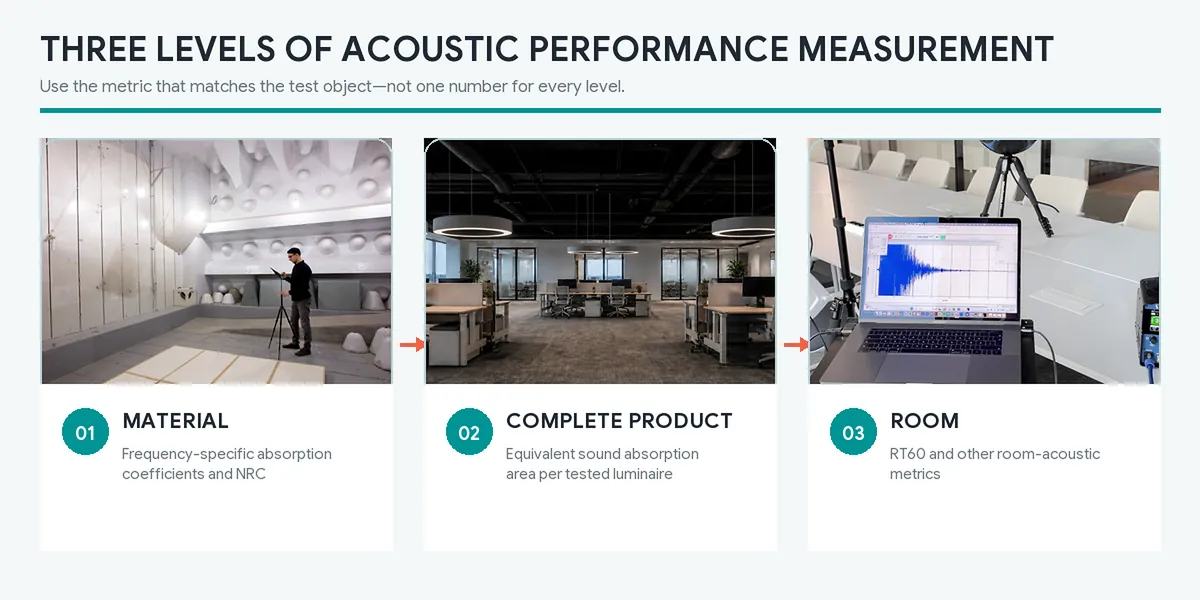
Level | Question Answered | Best Metric |
|---|---|---|
Material | How does the specimen absorb sound under stated laboratory conditions? | Frequency-specific α and NRC |
Complete product | How much absorption does one tested luminaire contribute? | Equivalent sound absorption area per unit |
Room | How does sound decay in the completed space? | RT60 and other room-acoustic metrics |
Level 1: Measuring the Acoustic Material
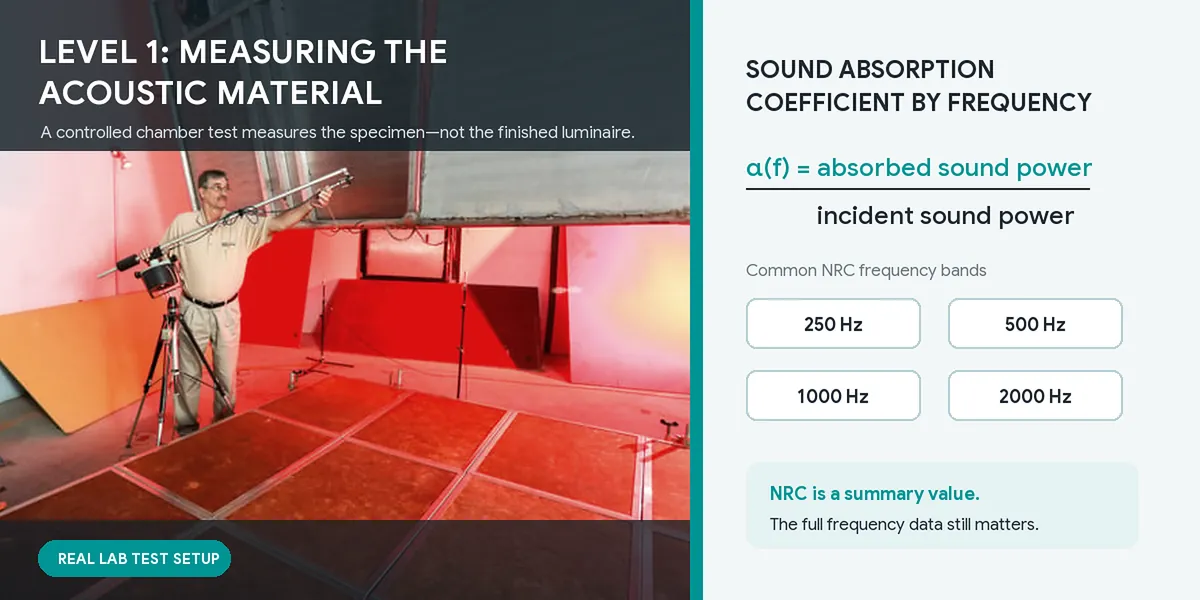
Sound Absorption Coefficient
The sound absorption coefficient, α, is frequency dependent. It represents the fraction of incident sound power that is not reflected by a surface under the stated test conditions. In reverberation-room measurements, edge diffraction can make the apparent coefficient exceed 1.0 when the result is divided by the specimen’s geometric area. This is a measurement effect, not absorption of more than 100% of the incident energy.
Why does sound absorption vary with frequency?
PET felt does not have the same sound absorption capabilities at all frequencies. Low-frequency sound (125–250 Hz) has longer wavelengths and interacts with porous materials differently than mid- and high-frequency sounds (1000–4000 Hz). Felts that perform well in the speech frequency band may have relatively limited control over low-frequency device noise. Therefore, technical assessments should look at complete sound absorption data for frequency bands such as 125, 250, 500, 1000, 2000 and 4000 Hz rather than just a single value.
What Does NRC Tell You?
NRC is the arithmetic average of the absorption coefficients at 250, 500, 1000, and 2000 Hz, rounded to the nearest 0.05. It is useful for quickly comparing specimens tested under the same conditions, but it does not show how performance varies by frequency.
What the NRC doesn’t tell you
The NRC cannot alone describe the final performance of a folded, suspended three-dimensional luminaire in a room, nor can it directly derive RT60, speech intelligibility, or user acoustic comfort. For complete luminaires, exposed backsides, air gaps, luminaire structural shading, geometry, orientation, and specific test configurations also need to be considered.
Why PET felt test results depend on test configuration
The same PET felt may obtain different sound absorption data due to different installation and testing methods. This is not a material defect, but a normal manifestation of the sensitivity of porous sound-absorbing materials to thickness, air layers, boundary conditions, and test configurations.
Thickness: With similar fiber structure and mounting conditions, additional thickness often improves absorption at lower frequencies. The change is not linear, so thickness should be evaluated together with the full frequency data and mounting configuration.
Density: Density changes airflow resistance and can affect acoustic performance. It also affects the stiffness and durability of formed PET felt components. Higher density does not automatically mean better absorption at every frequency.
Air gap: A cavity between the felt and a rigid mounting surface can improve absorption at some lower frequencies. The same material will produce different coefficients when tested directly against a surface and when tested with an air gap.
Installation conditions: The test report should specify conditions such as specimen size, installation method, air layer and boundary treatment. Material samples installed in the laboratory in a prescribed manner cannot be directly regarded as product-level data for complete suspended luminaires in the room.
Frequency range: A product that performs well across speech frequencies may provide less absorption at lower frequencies. Review the complete frequency table rather than relying on NRC alone.
Level 2: Measuring a Complete Acoustic Luminaire

Why Is a Suspended Luminaire Different From a Flat Panel?
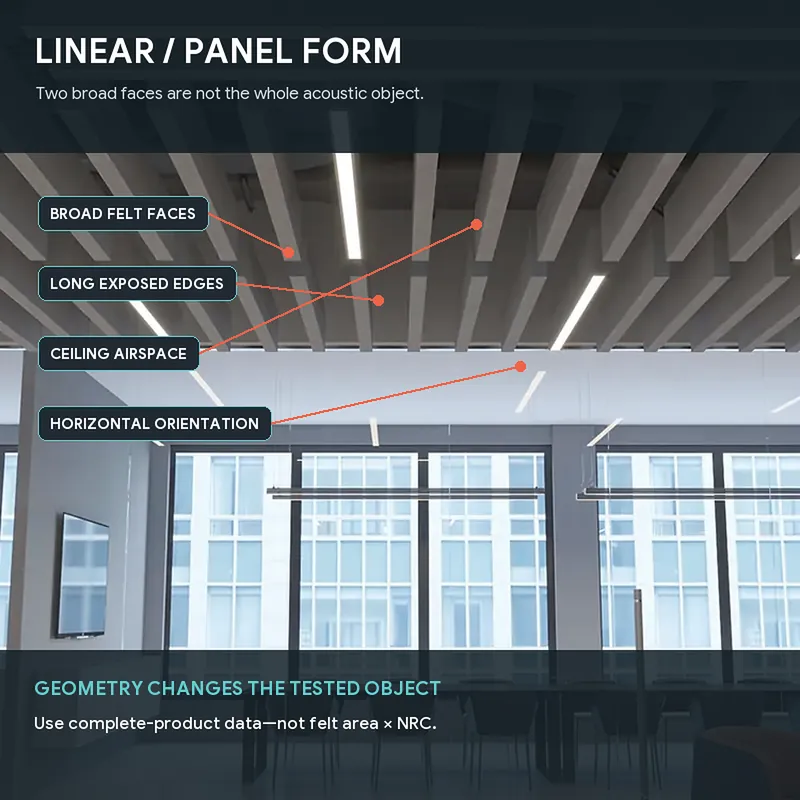
A flat specimen and a suspended acoustic luminaire are different test objects. A luminaire may expose its front, back, edges, and internal surfaces to the sound field, while its light engine and supporting structure can shield other areas. Geometry and mounting therefore need to be represented in the tested configuration.
ASTM C423 explicitly covers the measurement of “sound absorption by objects such as office screens.” This clause exists precisely because discrete objects behave differently than flat samples of material. Acoustic luminaires fall squarely into the object category.
Exposed surfaces and geometry
The exposed area of a complete luminaire is not necessarily the same as the area of PET felt used to manufacture it. A folded shade adds interior surfaces, a ring exposes inner and outer faces, and a curved form presents changing angles to incident sound. These differences are why fixture-level performance should be measured rather than inferred from material area alone.
Orientation
A horizontal panel, a vertical baffle, and a curved pendant expose PET felt to the sound field in different ways. Orientation changes which faces and edges interact with incident sound, so products made from the same material are not acoustically interchangeable.
The Air Around the Luminaire
Suspension creates an airspace above the luminaire and may expose surfaces that would be blocked in a surface-mounted configuration. This airspace is part of the acoustic configuration, not merely an installation detail.
Installation configuration
A pendant luminaire with the same PET PET felt area suspended 600 mm below the ceiling is not acoustically equivalent to a surface-mounted luminaire. Installation conditions change the boundary conditions of the absorber.
What Does Equivalent Sound Absorption Area Mean?
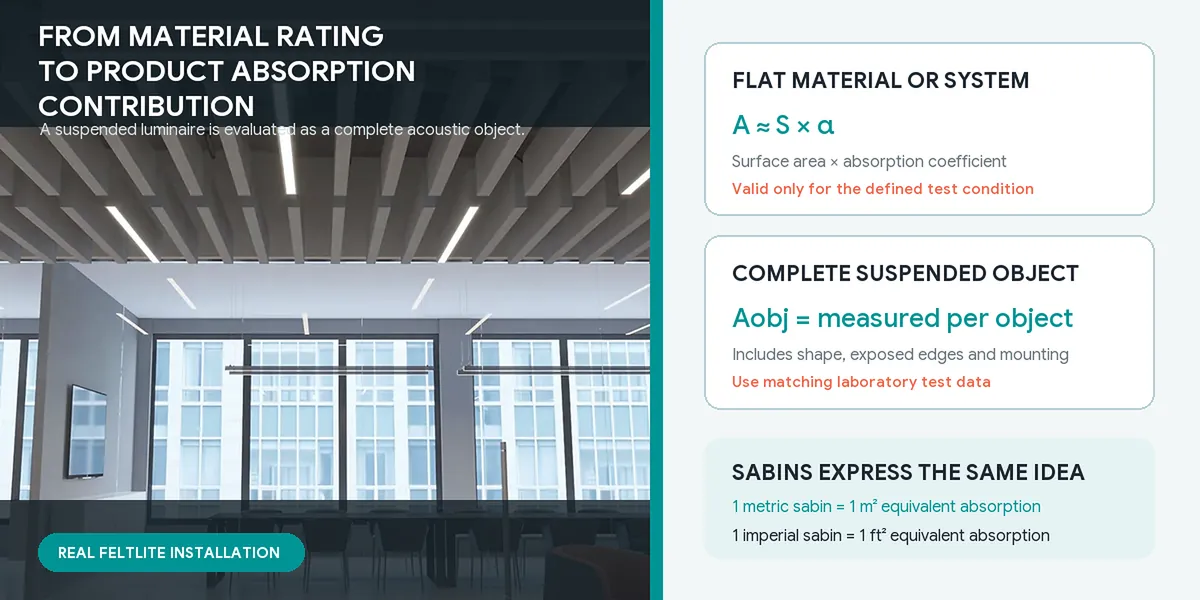
From Sound Absorption Coefficient to Absorption Area
For a defined flat surface, equivalent absorption area can be approximated as:
A = S × α
where S is the surface area and α is the sound absorption coefficient at the frequency being evaluated. For example, 10 m² of material with α = 0.50 at 500 Hz provides approximately 5 m² of equivalent absorption area at that frequency.
This relationship applies to surfaces where the material covers a well-defined planar area. It is not sufficient for discrete suspended objects because the effective exposed area and effective absorption coefficient of the object are not equivalent to the flat sample values.
Equivalent Sound Absorption Area for Discrete Objects
Equivalent sound absorption area is the area of an ideal surface with an absorption coefficient of 1.0 that would absorb the same sound power as the tested surface or object in a diffuse sound field. Metric reports use square meters per object; imperial reports may use sabins per unit. Always pair the value with its frequency and test configuration.
For acoustic lighting, this is an appropriate product-level metric. It answers the question: “If I install this fixture, how much sound absorption will it contribute to the room?”
Why Is Measured Product Data Better Than an Estimate Based on Felt Area?
Multiplying the approximate PET PET felt area of the fixture by the material NRC gives a number that looks like sound absorption data, but is not. It ignores geometry, edges, orientation, air cavities and the existence of the fixture body. For specifiers, the difference between calculated guesses and measured absorption values can mean the difference between hitting the RT60 target and falling short.
What Is a Sabin?
What Does the Unit Represent?
Sabin is an imperial unit of sound absorption, with 1 sabin equivalent to 1 ft² of ideally completely sound-absorbing area. Metric reporting usually uses square meters of equivalent sound absorption area. If a suspended acoustic luminaire tests 5 sabins at 500 Hz, it means that its sound absorption contribution at that frequency is equivalent to an ideal fully absorptive area of 5 ft².
Why Are Sabins Useful for Suspended Acoustic Products?
Sabin enables luminaires of different sizes and geometries to be compared on a common sound absorption basis. They are also directly incorporated into room acoustics calculations: total room sound absorption is equal to the sum of all surface sound absorption (area × coefficient) plus the absorption contributions from discrete objects.
Sabins per Unit vs. Material NRC
Metric | What It Describes | Typical Use |
|---|---|---|
Material NRC | A single-number average derived from four frequency bands for a stated specimen and mounting condition | Screening or comparing similarly tested materials and systems |
Equivalent absorption area per unit | The frequency-specific absorption contribution of one complete tested luminaire | Product comparison and room-calculation input |
Illustrative example only: not Feltlite product data: A 9 mm flat PET felt specimen might have an NRC of 0.70 under one specified mounting condition, while a complete suspended dome made from that felt could have a separately measured equivalent sound absorption area at 500 Hz. Both results may be valid, but they describe different test objects and answer different questions.
Why You Cannot Simply Multiply Fixture Surface Area by NRC
The central rule is simple: material NRC multiplied by luminaire surface area is not a valid replacement for complete-object test data.
The reasons are cumulative, not subtle corrections:
- Geometry: Folded or faceted shades have interior surfaces that receive sound at angles not present in flat panel testing. The effective sound absorption per unit material area changes accordingly.
- Edges: Edge diffraction can increase the apparent absorption measured for a finite specimen. Three-dimensional products may have more exposed edges than a flat sample, which is another reason to rely on a matching test configuration.
- Exposed side: A flat sample has only one exposed side. Suspended luminaires may have two, three or continuous curved surfaces.
- Air space: The air space between the luminaire and the ceiling and inside the folded form will change the acoustic boundary conditions and accessible sound field of the material. The actual impact is related to frequency, cavity depth and geometry, and should be based on the test data of the complete configuration.
- Installation: Laboratory installation conditions are standardized for repeatability. This is not the case with actual suspension.
- Assembly: Luminaires, drivers and structural parts occupy the volume and change the acoustic boundaries.
- Orientation: Horizontal panels and vertical baffles made of the same felt are not acoustically interchangeable.
How Does Fixture Geometry Change Acoustic Behavior?
The following forms show how geometry changes the way sound-absorbing material is exposed to the sound field. No form is universally best; each presents the PET felt to incident sound in a different way.
Flat-Panel Pendant
Horizontal acoustic panels with integrated luminaires present a large downward-facing surface. Sound absorption is strongest for sounds arriving from below – such as the speech of a seated user. The back may be partially obscured from the room by the fixture housing.
Vertical baffle
Vertical felt elements expose two wide sides to the room. This provides sound absorption from lateral sound paths, including inter-station reflections. Edge diffraction is more pronounced than with flat panels.
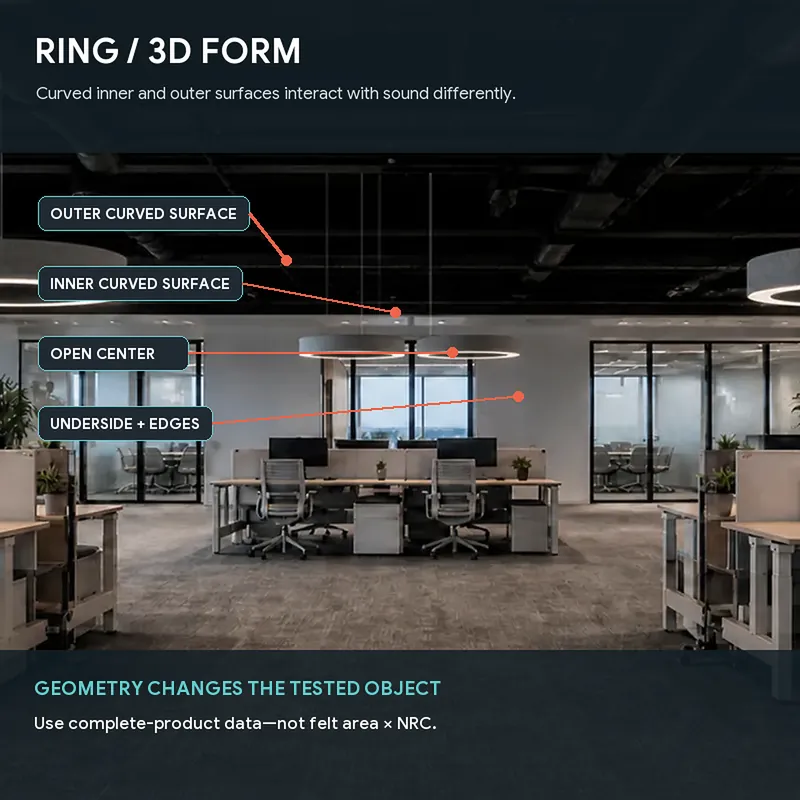
A ring pendant exposes inner and outer curved surfaces, while its open center allows sound to pass through. Ring depth, curvature, and mounting orientation change how the PET felt interacts with the sound field. Performance should therefore be based on the tested product configuration.
Dome Pendant
A dome presents a continuously changing angle to incident sound and creates an internal airspace. Its absorption cannot be assumed to equal that of a flat panel with the same material area.
Folded or Faceted Shade
Folded or faceted forms create multiple surface orientations within one luminaire. Some faces may align more directly with dominant sound paths than others. The folds also create internal airspaces and edges that contribute to the behavior of the complete object.
Does Suspension Height Affect Acoustic Performance?
The Role of the Airspace
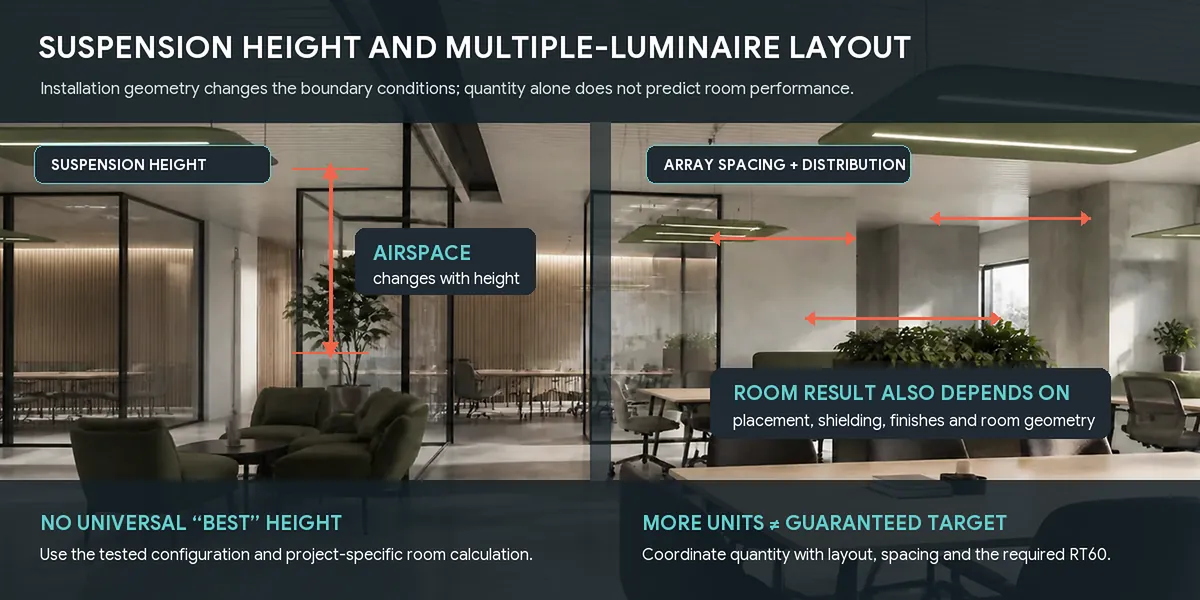
Suspending luminaires below the ceiling changes the acoustic boundary conditions. Air gaps above the luminaire can allow sound to reach areas that are blocked during surface mounting and can also change the position of the absorber relative to the user, the sound source and the early reflection path. The size of the effect depends on room geometry, frequency, hanging height and fixture configuration, and no unified conclusion can be drawn based on height alone.
Surface-Mounted vs. Suspended Installation
Surface mount acoustic fixtures have only one main exposed surface with no air gap above the felt. Suspended luminaires have additional exposed surfaces and defined air cavities. Even though the felt and luminaire are the same, they are different acoustic products.
Why There Is No Universal “Best Suspension Height”
Suspension height interacts with ceiling height, room volume, use, and the frequencies of concern. A configuration suitable for a 3.5 m open ceiling may not suit a 2.7 m conference room. Use project-specific calculations and data from a representative tested configuration.
What Happens When Multiple Acoustic Luminaires Are Installed?
From Single-Unit Data to a Room-Level Estimate
If one luminaire provides 3 sabins at 500 Hz, ten units may be treated as approximately 30 sabins in an early estimate only when spacing, shielding, and array effects are negligible. The final design should be checked against the tested array configuration, actual spacing, and room conditions.
Why Quantity Alone Is Not Enough
- Spacing: Fixtures placed close together can shield one another or concentrate absorption in one part of the room.
- Distribution: A central cluster over a conference table and a uniform ceiling grid can produce different room-level results even when their total rated absorption is the same.
- Room geometry: Long, narrow rooms and square rooms can behave differently even when volume and total absorption are similar.
- Existing absorption: Carpet, ceiling systems, furniture, finishes, and occupants all contribute to the room’s total absorption. Acoustic lighting is one input among many.
When Are Acoustic Calculations Needed?
When a project has an RT60 target or a speech-privacy requirement, use frequency-specific per-unit absorption data as an input to a room calculation. A product rating is not the final room result.
Level 3: Measuring the Room With RT60
What Does RT60 Measure?
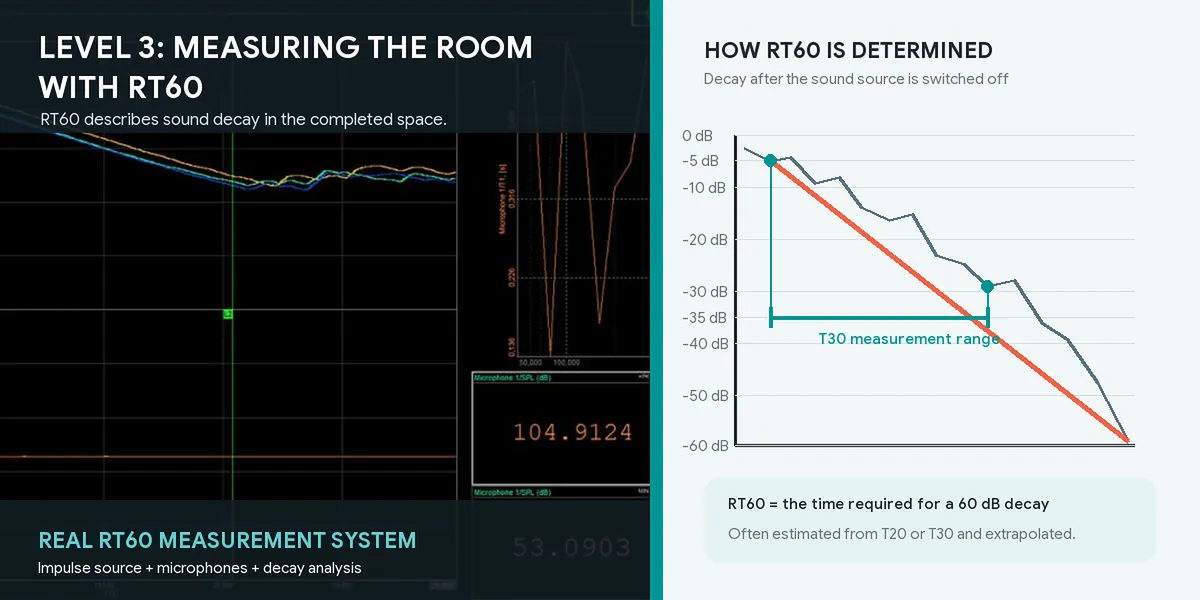
RT60 is the time required for the spatial average sound energy density in a room to decay by 60 dB after the sound source stops. It is a room attribute, not a single product rating. For spaces where verbal communication is the main focus, proper control of the reverberation time usually helps with clarity; however, the target value should still be determined based on the space use, volume and applicable standards, and shorter is not always better.
Why RT60 is a room metric, not a product rating
No acoustic luminaire has “RT60”. RT60 results from the interaction of the room volume, all surface materials, furniture, people, and any discrete sound absorbers including acoustic lighting. The luminaire affects RT60 indirectly through its absorption contribution.
What Affects RT60?
- Room volume (larger volumes generally require more absorption to achieve the same RT60)
- Ceiling materials and installation methods
- Wall surfaces and finishes
- Floor covering
- Furniture and soft furnishings
- Occupants
- Acoustic lighting and other suspended sound absorbers
- Background noise and measurement noise floor (mainly affects RT measurement reliability and actual acoustic experience)
For a deeper explanation of the difference between a material rating and a room metric, see “NRC vs. RT60: Understanding Acoustic Performance Metrics.”
NRC vs. Equivalent Sound Absorption Area vs. Sabins vs. RT60
The table below summarizes four common categories of metrics. When determining whether data is applicable, first confirm whether it corresponds to materials, complete products, or actual rooms.
Metric | Measures | Level | Best Used For |
|---|---|---|---|
Sound absorption coefficient (α) | Frequency-specific absorption of a surface or system | Material or system | Technical evaluation by frequency |
NRC | Single-number average of absorption at 250, 500, 1000, and 2000 Hz | Material or system | Quick comparison under matching test conditions |
Equivalent sound absorption area | Frequency-specific absorption contribution of a discrete object | Complete product | Suspended acoustic products |
Sabins or m² per unit | Quantity of equivalent absorption | Product and room calculation | Planning and RT60 estimation |
RT60 | Reverberation decay time in the completed space | Room | Room performance and use-specific criteria |
Laboratory Data vs. Real-Room Performance

What Does Laboratory Testing Provide?
Reverberant chamber testing to standards such as ASTM C423, ISO 354, etc., provides comparable sound absorption data under controlled conditions. Comparisons between data are only meaningful if conditions such as specimen, mounting method, size, array, and reporting frequency are consistent or adequately described.
What Changes in a Real Project?
Real rooms contain non-diffuse sound fields, irregular geometry, furniture, occupants, and building services. ASTM C423 notes that coefficients measured under repeatable laboratory conditions should be applied with judgment because practical conditions differ from an ideal diffuse field.
Why test data is an input, not a room guarantee
A product’s measured equivalent sound absorption area is an input to a room calculation, not a guarantee that the completed room will achieve a specified RT60. The laboratory-to-field gap does not invalidate test data; it defines how that data should be used.
How Should Acoustic Lighting Test Data Be Evaluated Before Specification?
This checklist is intended for specifiers, acoustic consultants, and procurement teams reviewing submittal datasheets.
Confirm the Test Object
Was the test performed on a flat material specimen or on the complete luminaire? If a datasheet lists “NRC 0.90,” ask what was tested, how it was mounted, and whether the value applies to the specified product.
Check the Test Standard
ASTM C423 and ISO 354 are both common standards for measuring reverberant room sound absorption. If the data does not indicate standards, laboratories, specimens and installation configurations, it cannot be judged to be the actual measurement results of a complete product based on just one acoustic value.
Check the Product Size and Configuration
Object test data is only valid for test configurations. equivalent sound absorption areas for 600 mm pendant luminaires cannot be transferred to 1200 mm pendant luminaires without verification.
Check the Installation Conditions
Material data should identify the mounting condition, specimen size, airspace, and edge treatment. Object data should identify the suspension condition and, when applicable, the tested array spacing.
Review the Frequency Data
A single NRC or averaged absorption value can hide important frequency-dependent behavior. Request the complete octave-band or one-third-octave-band results used for the rating.
Confirm That the Specified Product Matches the Tested Product
This is the most common failure point. The datasheet may quote the material NRC reported for the supplier’s flat sample, while the actual fixture uses felt of a different thickness, density, or molding process.
Check | Question to Ask |
|---|---|
Test object | Was a material specimen or the complete luminaire tested? |
Standard | Was the method ASTM C423, ISO 354, or another documented standard? |
Configuration | Does the tested size and form match the specified product? |
Mounting | How was the specimen or object installed, suspended, or arranged? |
Frequency data | Is the full frequency table available? |
Product match | Do the production material and construction match the tested sample? |
Worked Example: From Product Data to Room Planning
The following is a method demonstration, and the numbers do not represent the actual measured data of Feltlite products. Actual projects must use equivalent sound absorption area data that match the specified model, size and installation configuration, combined with the complete input conditions of the room.
Room: Open office, 12 m × 8 m × 3 m (volume: 288 m³).
Atarget = 0.161 × VRT60
If the measured equivalent sound absorption area of a complete acoustic luminaire at 500 Hz is 3.5 m², the preliminary quantity is approximately:
59.3 ÷ 3.5 ≈ 17 units.
Coordinate the acoustic estimate with the lighting layout:
Illustrative result: Under these assumptions, the early estimate is approximately 17 luminaires. This example shows the calculation method only. A real project requires frequency-specific verification and, for an open office, consideration of spatial decay, background noise, speech intelligibility, and the lighting design.
Conclusion: Use the Right Metric at the Right Level
Material metrics describe materials; product metrics describe acoustic objects; room metrics describe spaces.
Confusing material, product, and room metrics creates specification risk. The room may miss its target, a submittal may fail to answer the consultant’s questions, or a product claim may lack evidence from a matching test configuration.
A sound specification should not stop with “What is the NRC?” It should also ask: What was tested? How was it tested? Does the tested configuration match the specified luminaire? How will that product-level result be used in the room calculation?
What is the NRC?
Instead, you should continue to ask:
What was tested, how was it tested, and how does that data relate to this product and this room?
Feltlite technical documentation should state what each acoustic value describes, the test conditions behind it, and how the value can be used in project evaluation. Material data should not be presented as a guaranteed room result.
Need acoustic data for a project specification?
To identify the most relevant available documentation for a specific product and project, provide the Feltlite technical team with the following information:
- Room type and size
- Reflected ceiling plan (RCP) or layout sketch
- Acoustic goals (if RT60 is specified, or overall intent)
- Product form of interest
Contact Our Technical Team
Technical References
ASTM C423: Standard Test Method for Sound Absorption and Sound Absorption Coefficients by the Reverberation Room Method. ASTM International
ISO 354: Acoustics : Measurement of sound absorption in a reverberation room. International Organization for Standardization
Definition of equivalent absorption area. ASA Standards Terminology
FAQs
1. Does acoustic lighting have an NRC rating?
Material used in an acoustic luminaire may have an NRC based on a defined specimen and mounting condition. A complete suspended luminaire is often better described by frequency-specific equivalent sound absorption area per unit. Always confirm the test object before comparing ratings.
2. What is the equivalent sound absorption area?
Equivalent sound absorption area is the area of an ideal surface with an absorption coefficient of 1.0 that would absorb the same sound power as the tested object. For a suspended luminaire, it expresses the product’s absorption contribution by frequency.
3. What is Sabine?
A sabin is an imperial unit of equivalent sound absorption. One sabin equals the absorption provided by 1 ft² of an ideal perfectly absorptive surface. Metric reports generally use square meters of equivalent absorption area; the two units should not be mixed.
4. Are NRC and RT60 the same?
No. NRC is a single-number rating derived from a tested material or system specimen. RT60 is the time required for sound energy in a room to decay by 60 dB. NRC may be one input to a room estimate, but it is not a room-performance result.
5. Does thicker PET felt always absorb more sound?
Not at every frequency or under every mounting condition. Greater thickness often improves lower-frequency absorption, but fiber structure, density, airflow resistance, airspace, and mounting also matter. Compare complete frequency data from equivalent test configurations.
6. Does suspension height affect acoustic performance?
Yes, but there is no universal best height. Suspension changes the airspace, exposed surfaces, and the luminaire’s position within the sound field. The effect depends on room geometry, frequency, fixture design, and the tested mounting configuration.
7. How to compare two acoustic luminaires?
Compare frequency-specific equivalent sound absorption area from tests of the complete products. Confirm that the tested size, geometry, material, mounting, and array spacing match the products being specified. Material NRC alone is not enough.
8.How many acoustic luminaires are needed for a room?
The quantity depends on room volume, existing absorption, the target RT60, and the tested absorption contribution of each luminaire. Use those inputs in a frequency-specific room calculation, then coordinate the result with the lighting layout.
9. Should complete acoustic luminaires be tested?
Complete-product testing provides more useful specification data than a flat-material rating when geometry, exposed surfaces, and mounting affect performance. The tested configuration should match the product being specified as closely as practical.